

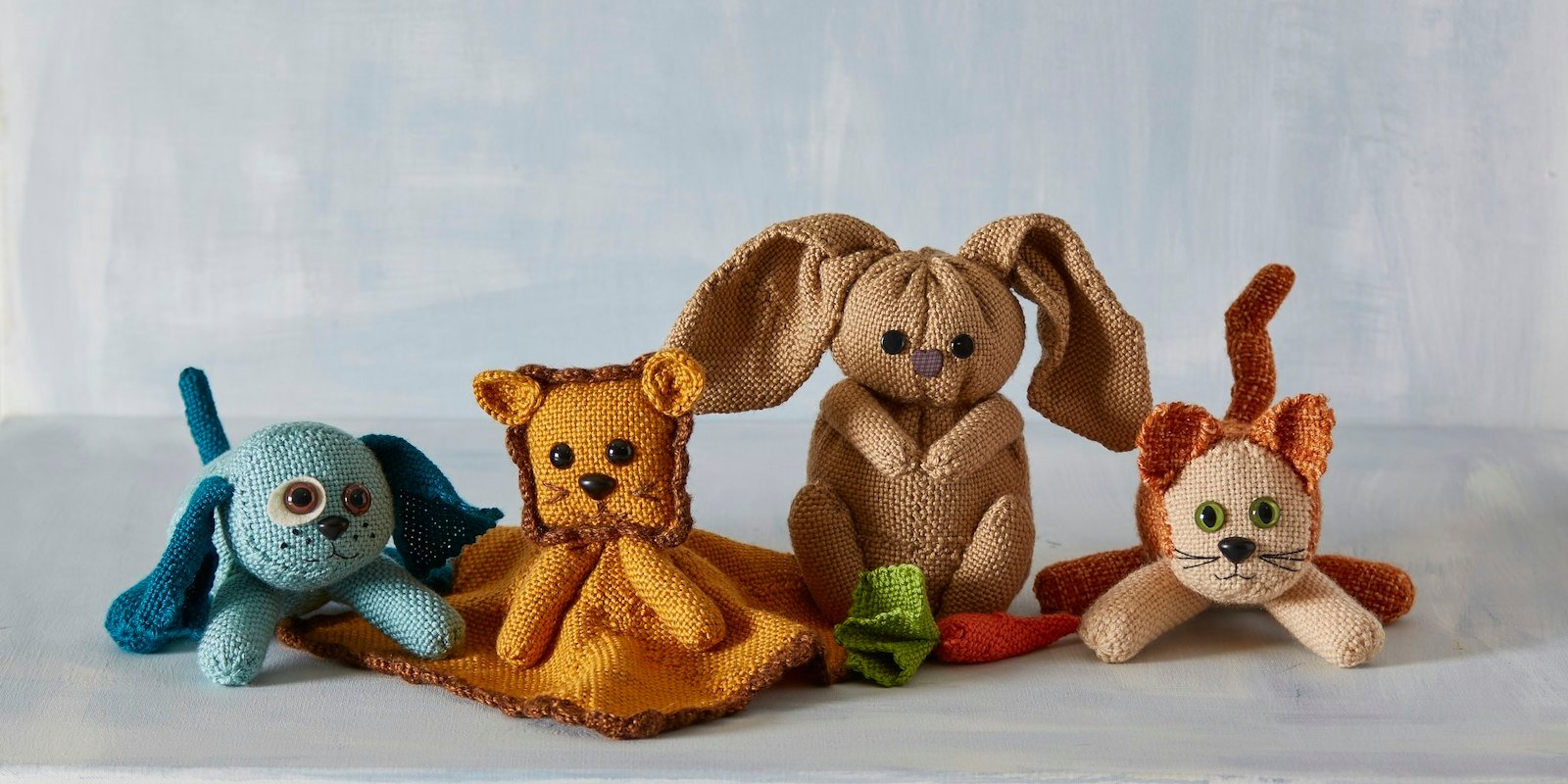
Designer Deborah Bagley is truly a master of the pin loom, but she didn't start out that way. While today Deborah uses pin-loom cloth to create everything from beautiful kitchen towels to an incredibly detailed submarine stuffy, she started out like most of us: wondering what to do with all those squares (or hexagons or triangles). Fortunately, Deborah took that question as a challenge and has become one of the most prolific pin-loom weavers I know. In this artist spotlight, originally published in the Holiday 2020 issue, Deborah recounts her journey from skeptical newbie to pin-loom artist. If you find yourself inspired by Deborah works and words to build your own pin-loom weaving skills, check out our Confident Weaver's Guide to Pin Loom, a special resource page dedicated to all things pin loom.
—Christina
 Deborah’s Market Vegetables collection was one of her first forays into three-dimensional projects. Photo by George Boe
I confess, when my sister first introduced me to pin-loom weaving in 2016, I was sure I wouldn’t weave more than a few squares, especially since my first square fell apart as I took it off the loom. I thought, What on earth can you do with a bunch of little squares, I mean besides the obvious coaster and blanket?
At first, I did create two-dimensional objects, including a set of scarves and a rug, both of which were featured in Easy Weaving with Little Looms 2017. Shortly thereafter, my sister started playing around with shaping, I joined her, and along came the vegetables I wove and constructed that were featured in Little Looms 2018. Suddenly, there were no limits!
Expanding Into New Dimensions
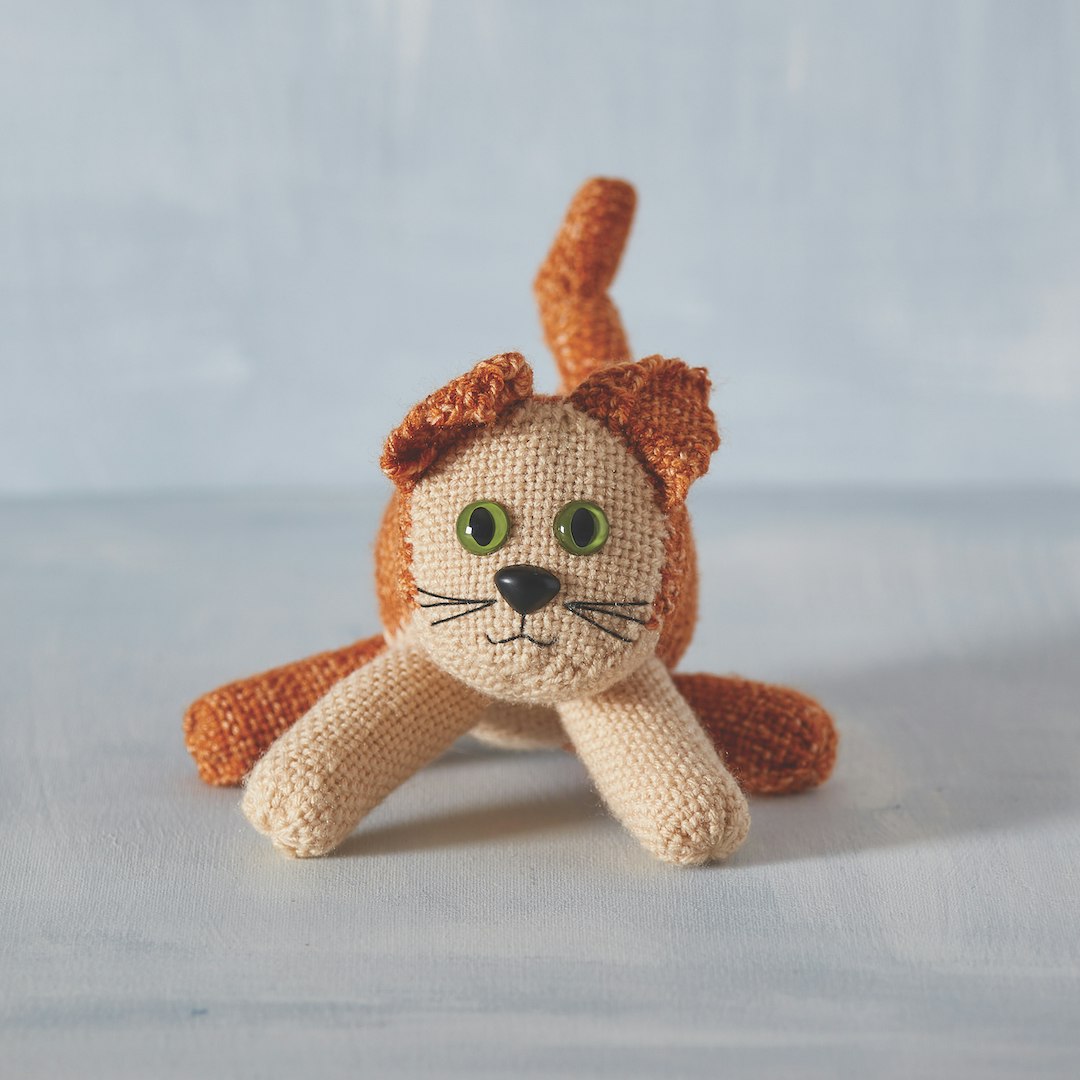 All the pin-loom projects in Deborah's Zoo Crew eBook were made entirely from 4"-square pin-loom pieces, including the Kitty Cat shown here. Photo by George Boe
At the beginning of my pin-loom journey, I had only a 4-inch square loom. Though I like learning new weaving patterns, I found that what I truly enjoy is building and constructing three-dimensional items. I kept experimenting with folding and shaping. Soon I found that with the right folds, I could create just about anything—including a menagerie. After designing a dozen animals and animal-themed projects, my first pin-loom eBook, Zoo Crew, was born.
It was while creating that cast of critters that I decided I needed pin looms of various sizes and shapes. I no longer was content to weave 4-inch squares only to fold them in half and waste time and yarn on cloth that would be hidden inside a project. For my next looms, I carefully chose rectangles and triangles that would coordinate with my 4-inch loom. Shortly thereafter, I wove a bunch of purses and other bags, one of which was featured in Little Looms 2019.
 The Chevron Scrapghan from Holiday 2020 features colorful pin-loom triangles interspersed with areas of crochet. Photo by Matt Graves
I soon discovered that cloth woven on 2-by-4-inch and 2-by-6-inch looms made lovely straps. Though I had owned a 4-inch triangle for a while, I wasn’t using it often—then I realized that triangles are perfect for creating chevron patterns, and out of that discovery came my Chevron Scrapghan. I’ll admit that when designing it, I wanted to avoid having a large number of ends to weave in, which is why I interspersed the chevron rows with crochet, although you can absolutely weave the whole blanket using a 4-inch triangle loom.
Weaving a Seascape
 Every element in this shark scene was woven on a pin loom and carefully shaped and folded to create the finished, vibrant seascape. Photo by Matt Graves
In 2019, I saw a weaving competition open to three-dimensional works no larger than 18 inches in any direction. What a perfect challenge for a pin-loom weaver like me! Initially, I planned to enter my hammerhead shark, but the more I thought about it, the more I realized that surely a hammerhead stuffed animal would not win all by itself. I decided to build my shark a seascape.
For my first step, I created a foam base upon which to attach all the pieces. Then I began to visualize what I would put on the base and how to best weave and shape the objects using my looms. The first element I visualized was the tube coral, which is basically a cylinder and thus easy to make from a square. Real corals aren’t all the same size, so I made a 1-inch loom from a small piece of foam board and pins using a template I shared in the Pin Loom Weaving group on Facebook. With a gentle hand, I was able to use this fragile setup to weave many items in the seascape, including the sea cucumbers, clams, and starfish.
 One of the challenges Deborah faced while weaving her seascape was creating different varities of coral out of pin-loom pieces. Photo by Matt Graves
The real challenge was the fan coral. Fan coral looks delicate and curved, and a pin loom square is neither delicate looking nor curved. I tried several ways to get a fan shape and ultimately decided upon untwisting a length of four-ply yarn to get a two-ply strand. After weaving each square, I starched it heavily before pinning it into the desired shape to dry.
After weaving 127 squares and rectangles, the diorama was complete. Even though my seascape didn’t win the competition, I had a lot of fun making it. It showed me once again just how versatile pin-loom weaving is. When people ask me what I can make with pin-loom squares, I want to say, “Almost anything!”