

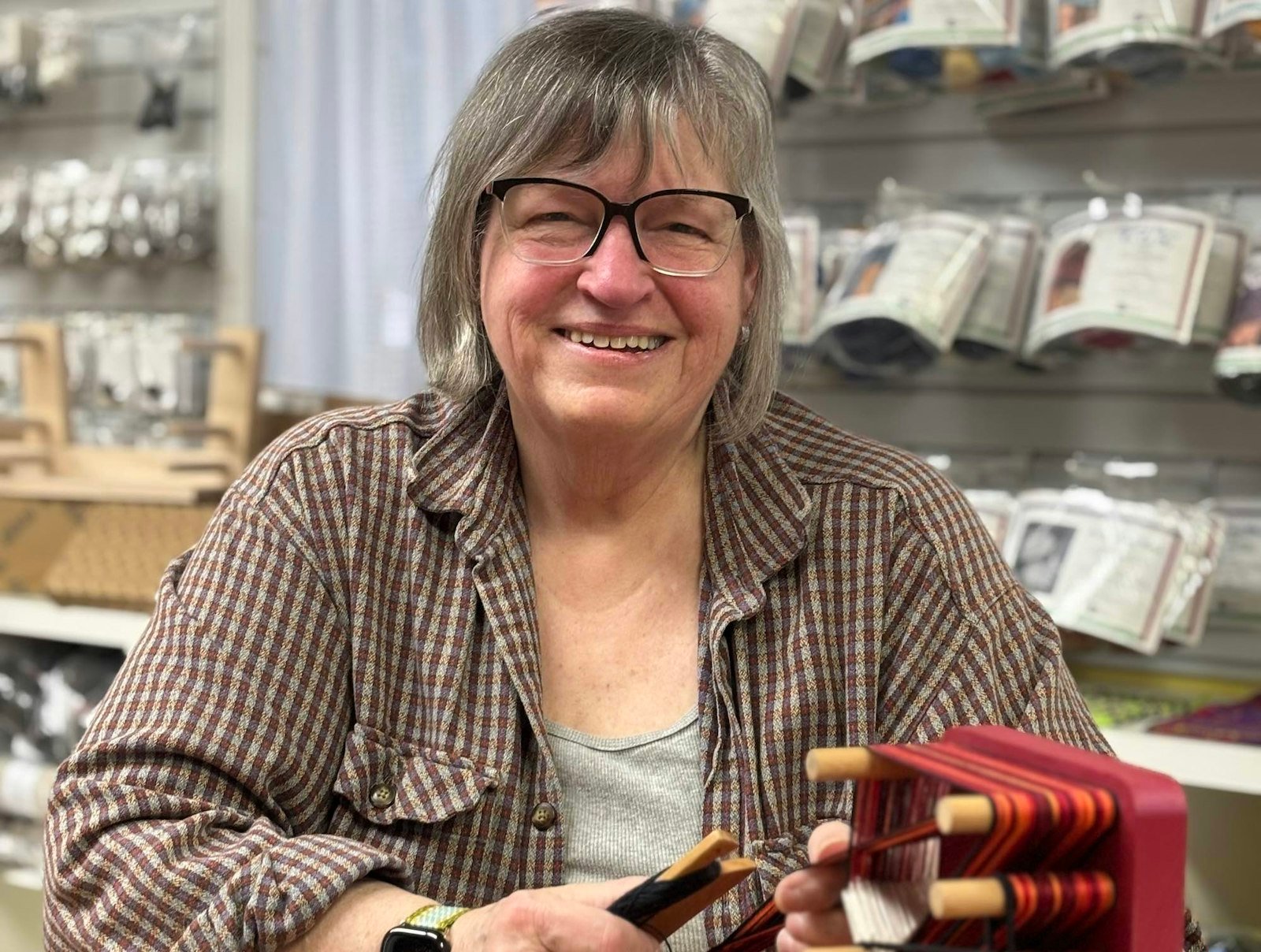
Welcome to another installment of “Five Questions with,” our series in which we ask different Easy Weaving with Little Looms authors and designers five questions to get to know them a bit better. This time we’re talking to frequent Little Looms designer and the owner of Heritage Spinning & Weaving, Joan Sheridan.
I first “met” Joan Sheridan in 2020. While trying to find some inkle projects for our first ever Holiday issue, I asked Anne Merrow whether she had recommendations for inkle weavers who might be interested in designing something for us. Anne immediatley told me that I should talk to Joan because she was both a talented weaver and an absolute delight to work with. I emailed Joan to see whether she would be interested, and she quickly replied with enthusiasm and ideas—I could see exactly why Anne liked her so much!
Those digital conversations led to two projects in the Holiday 2020 issue and many, many more throughout the years. Working with Joan is still a delight, which is why I’m so excited that she’ll be joining us at Weave Together with Handwoven 2027 where she’ll be teaching three incredible classes, which you can learn more about here.—Christina
 Joan Sheridan’s Guitar Strap in Turned Krokbragd from the Holiday 2020 issue. Photo by Matt Graves
C: Tell us a little bit about your journey with weaving, how you got started, and especially what drew you to bandweaving.
J: In the 1980s, there was a weaving shop in Ann Arbor, Michigan, called The Wild Weft. At the time, I was working at the University of Michigan and often explored downtown shops during my lunch hour. This shop stopped me dead in my tracks. Looms! Weaving! Fabric! I fell head over heels in love. I left with a loom brochure, an issue of Handwoven magazine, and a dream.
The dream finally came true in 1999. After taking some fiber classes at a local farm festival, I learned of a used loom for sale. The owner could feel my passion and gave me not only the small floor loom, but also an old copy Deborah Chandler’s book Learning to Weave. I ordered a reed and yarn from the Yarn Barn of Kansas, and once I had everything in hand, I taught myself to weave.
The more I learned, the more I discovered there was to learn—I realized that I would never, ever be bored with weaving. So, I did the only sensible thing one could do—I opened Heritage Spinning & Weaving as my retirement business at the age of 42.
I was comfortable weaving on a floor loom, but that little inkle taunted me and seemed to be just out of my grasp. Because trying to teach myself with books wasn’t clicking for me, I engaged Daryl Lancaster to come and teach some classes at the shop—including an introduction to inkle weaving. Darly’s class helped me understand the mechanics of inkle weaving and started me on a bandweaving adventure that gets better with each passing year.
 Joan wove this flock of sheep–patterned inkle band using turned krokbragd. Photo by Matt Graves
C: I know you do a lot of different types of weaving, but when I think “Joan Sheridan,” turned krokbragd on the inkle loom is what first comes to mind. What is it that you love about this structure and what made you try it in the first place?
J: I discovered turned krokbragd because of Anne Dixon’s book, The Weaver’s Inkle Pattern Directory—but there is a back story to why it caught my attention. During a trip to Norway, I was introduced to their rich textile traditions—including multi-shaft woven krokbragd rugs and wall and bed coverings.
While I enjoy weft-faced krokbragd, it is slow weaving. As I read Dixon’s section on the structure, I discovered that with turned krokbragd I could “translate” patterns from the pieces I’d seen in Norway—plus, bands weave so much more quickly than a rug!
C: How do you approach projects in bandweaving—do you build your pieces around specific findings or project types, or do you weave the band first and then figure out what to do with it? What’s the most unusual thing you’ve made from your bands?
J: That’s a hard question. Turned krokbragd must be planned in advance so that the loom can be set up properly. Plain weave, which I love, better accommodates designing on the loom. I just finished a project for an upcoming issue Little Looms that I tried to plan ahead of time, but it just wasn’t happening; sometimes art cannot be forced—it has to flow. I decided to design my band as I dressed the loom, the palette I selected inspiring a design with flashes of color, asymmetry, and a few stripes in both the warp and weft. It worked, and it is one of my favorite bands to date.
I weave for both the sake of weaving and for specific uses. Because I create plain-weave and turned-krokbragd kits for my store, I don’t always have to know what the band will be when it “grows up.” Feedback from the weavers who use my kits tell me that they appreciate having a pattern to follow and the colors ready to go. This inspires me to create more. I am now working on a “nature” themed series of bands that should be out later this year.
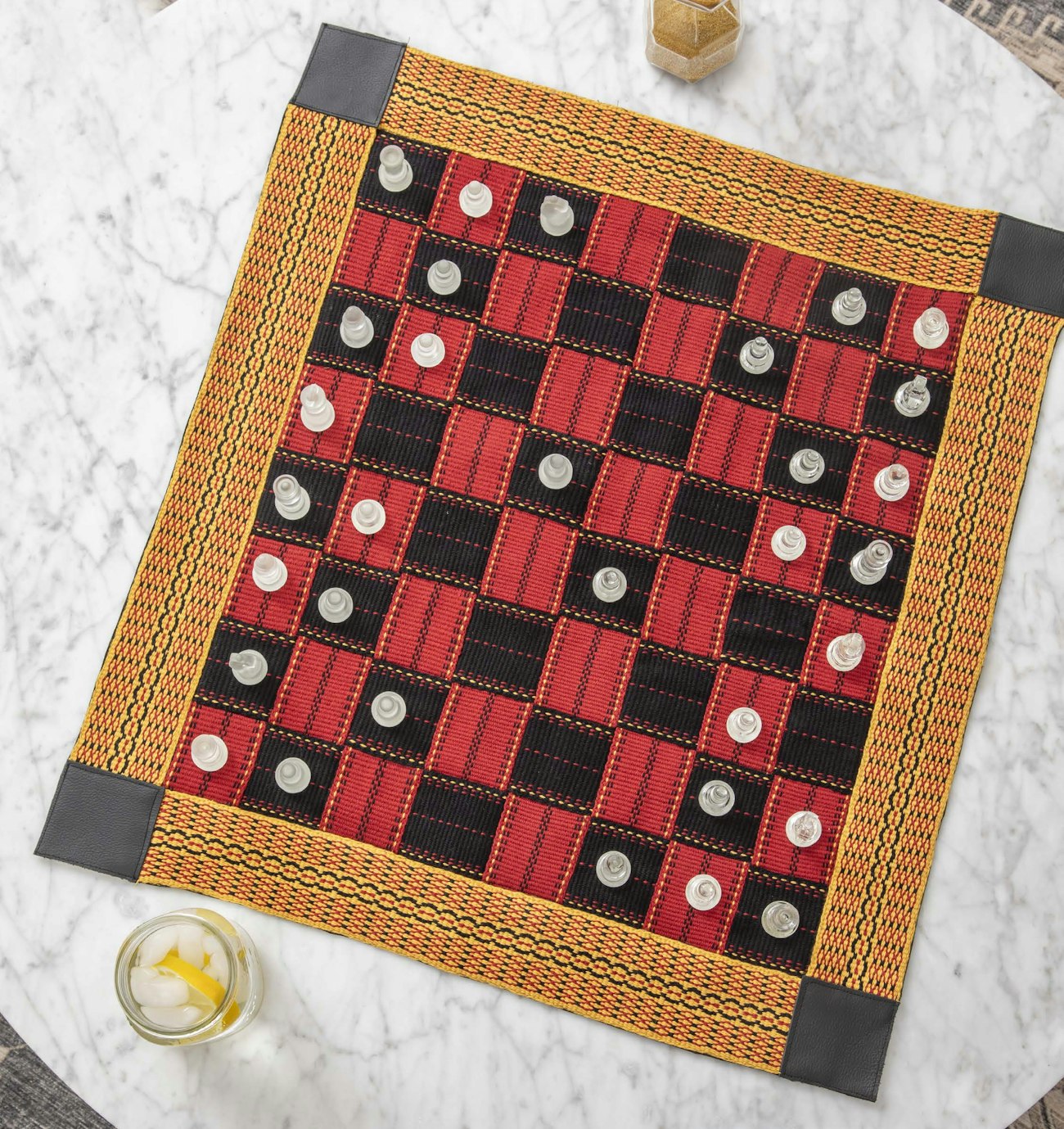 Joan's Royal Chessboard is made from three inkle bands with a combined length of almost 13 yards! Photo by Matt Graves
When I think about unusual uses for bands, the Royal Chessboard from Little Looms Spring 2024 comes to mind. It is a full-sized chessboard made from interlaced plain-weave bands in red and black that are in turn surrounded by a golden turned-krokbragd border. I had always wanted to weave a checkerboard in doubleweave on the floor loom, so when a call for projects asking for projects focused on squares and rectangles came along, a chessboard woven out of bands immediately came to mind. It certainly was a lot of weaving, but I am pleased with the end result.
C: What inspires you as a weaver?
J: Everything! I see patterns and color everywhere and think about how they would apply to bands and yardage. Bryan Talbot, an amateur photographer, shares his bird images with our local Facebook group. His work inspired two collections of band designs that I sell in kits and as PDF downloads. The most popular are the cardinal, bluejay, and chickadee.
I have always enjoyed history. In fact, in my spare time, I work as a textile specialist conserving any number of things, and the samplers I work with are a big inspiration. I am currently noodling out how I can incorporate cross-stitch motifs into bands. One of my students showed me a Norwegian band from the late 1800s that she found at a rummage sale. I took photos and created a pattern so it could be woven as a reproduction, and the band has since been donated to The Vesterheim Norwegian-American Museum in Decorah, Iowa.
I have an inspiration binder filled with photos gathered from my travels and discovered online photos. I have many images from Norway, from museums, from public spaces (look at the floor, look at the ceiling!), and even one of a snake. Thumbing through the binder can act as a spark. I love creating my own original designs to interpret things around me.
C: What’s on your looms right now?
J: Much of my weaving is driven by class prep or by publication dates, so I only have one “for fun” project on my Octado floor loom, and it has been there for way, way too long. It is an overshot name draft for my Norwegian friend in white and blue linen. It must be finished soon, though, as I need the loom to weave a blanket for an upcoming waulking.
 Joan and Annie MacHale enjoying a rare in-person bandweaver meetup at the Michigan Fiber Festival. Photo courtesy of Joan Sheridan
On my band looms I have two tablet-weaving projects, two different Baltic pick-up patterns (one in scrumptious silk), turned-krokbragd sheep, yards of tape, and a sample plain-weave band testing Aurifil 12 weight cotton. My newest project, a three-color pick-up band in a cheerful palette, is inspired by Annie MacHale who I had the pleasure of spending time with at the Michigan Fiber Festival this year. What a treat it was to meet Annie in person and talk inkling at a deep level—that doesn’t happen very often because of the niche nature of this weaving style.
Not to be forgotten are two rigid heddles, one with krokbragd (weft-faced) and one with a very colorful rep-weave project, as well as several tapestry looms nagging me to get back to work on them!
So many things to explore! When I started my store, I knew I would never be bored. I was right. Weaving is so simple—it’s just the interlacing of threads—but the possibilities are endless, and I remain enamored with the potential.