
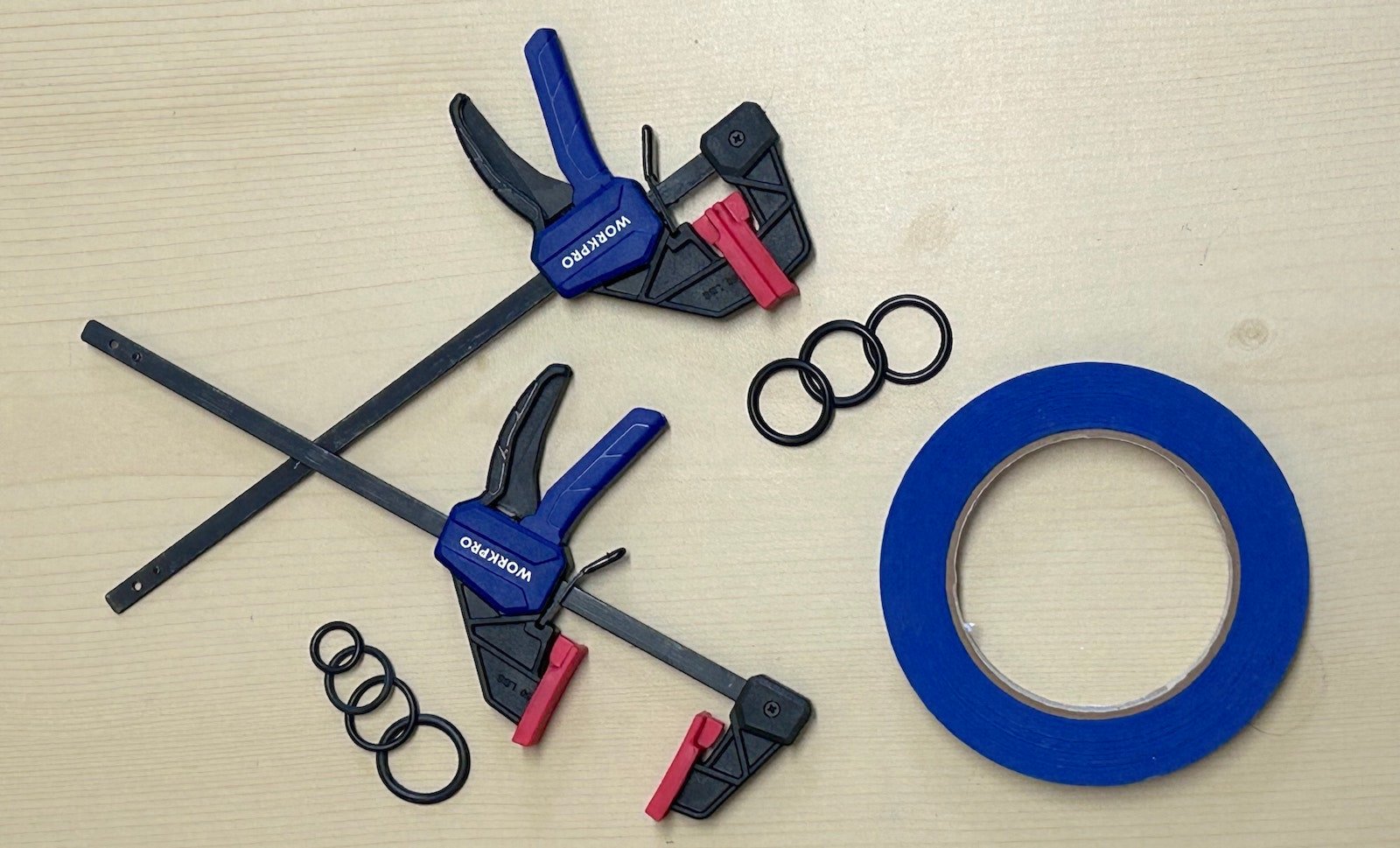
Throughout the years I’ve learned from expert weavers a lot of tips and tricks that have genuinely improved my own weaving experience. More than a few of these tips have to do with nontraditional tools and supplies—including a surprising number of items you can probably find at your local hardware store. Here are just a few that I have used and can vouch for personally.
O-Rings
 O-rings positioned on the end of inkle pegs help keep warp threads from slipping off. Photo by Christina Garton
Designed for plumbers, O-rings are rubber rings that come in a wide range of sizes and styles. You can put them on the end of the pegs on your inkle loom to keep your warp from sliding off (a tip I learned from Jennifer B. Williams). Similarly, you can also put them on either end of your heddle rod to keep string heddles from slipping off the back as you add new ones to the front.
Choose an O-ring with the same inner diameter (sometimes abbreviated as ID) as the inkle peg or dowel you’ll be putting it on. You may also see measurements for the outer diameter (sometimes abbreviated as OD) and the ring's thickness. If you have a choice between a rounded or flat O-ring, go for the rounded option. The thickness of the ring itself doesn't matter nearly as much—I found out I could buy a multipack with O-rings in a variety of thicknesses for less money than buying O-rings that were all exactly the same.
Quick Clamps
 Quick clamps can attach to virtually any surface. Photo by George Boe
Also known as trigger clamps, theses easy-to-tension tools make excellent warping pegs. I’ve used them to measure and wind warps for backstrap weaving and for direct warping my rigid-heddle loom, tricks I learned from Kate Larson and Elisabeth Hill, respectively. In fact, I find quick clamps tend to be more versatile than traditional warping pegs. They fit on thicker surfaces than warping pegs—while still tensioning just fine on thin ones. You can tension the clamp with just one hand, and I find squeezing the trigger to tension more ergonomic than twisting a wing nut.
Painter’s Tape
 Helping to organize threads while warping your inkle loom is just one of the many ways weavers can use painter’s tape. Photo by Christina Garton
If I were to pick just one item from this list that has made the biggest difference in my weaving life, it would be painter’s tape. I use it to help organize inactive ends while warping my inkle loom—a technique I learned from this Joan Sheridan video—and to keep my string heddles in place on my heddle rods. You can put it on your rigid heddle, write notes or measurements on the tape, and then easily remove it when the weaving is done. Need to step away from your loom for an extended period and don’t want to forget your pick-up sequence? Write it on painter’s tape and stick it to the side of the loom. Making a large-scale pin-loom project and need to keep your pieces organized? Put them in reusable bags or bins labeled with—you guessed it—painter’s tape.
I could go on and on—this stuff is endlessly useful. I always have a few rolls on hand at any given time. I use the medium strength painter’s tape because it adheres well to my loom, it can be removed and re-adhered multiple times before losing its adhesive abilities, and it doesn’t leave a sticky residue.
More to Explore
These are only a few of the useful weaving items you can find at the hardware store—I didn’t even cover supplies for loom care and maintenance! If you enjoyed this list or have some hardware-store hacks of your own, let us know, and we might make this a series.
Happy Weaving!
Christina