

Contents

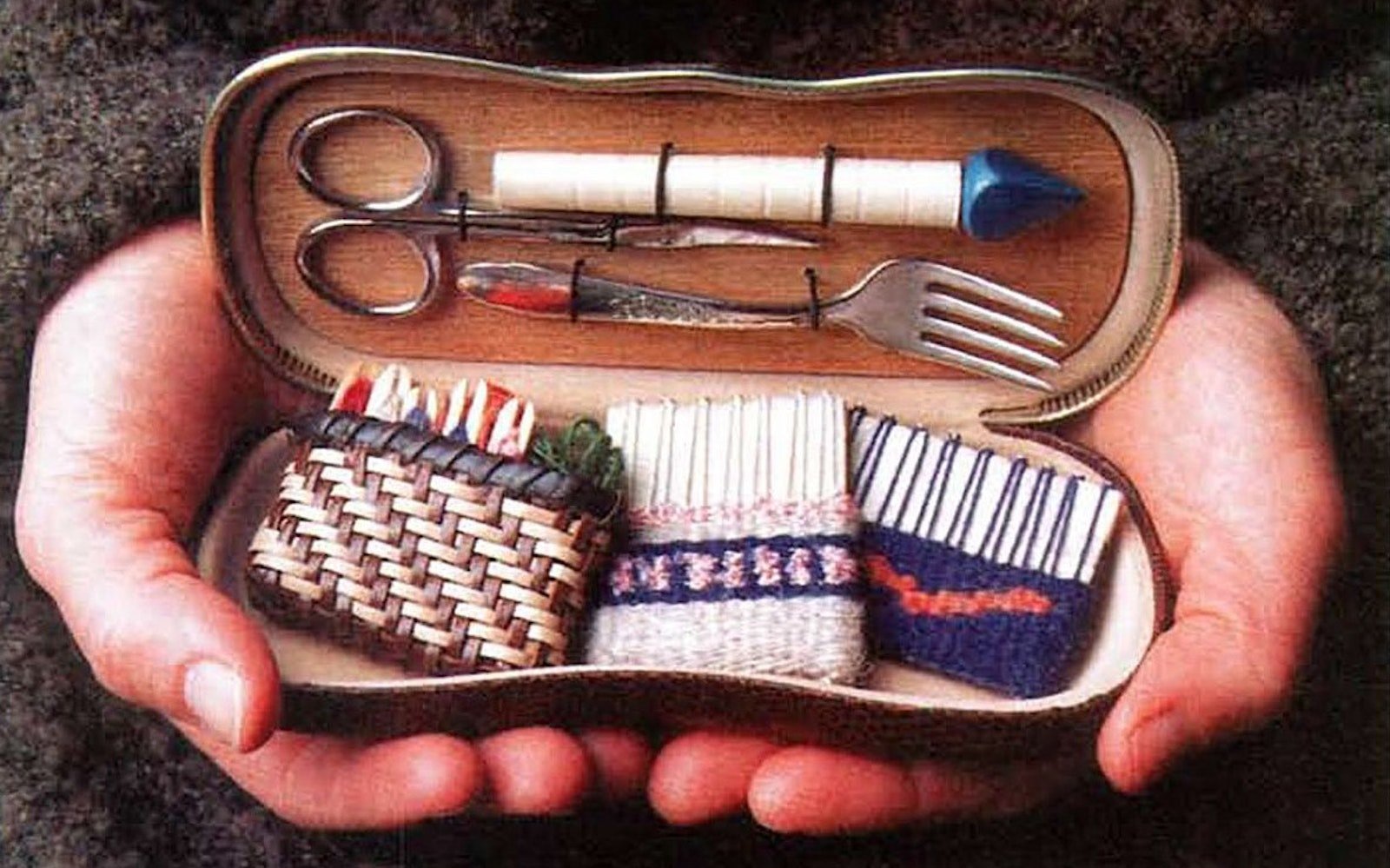
Recently I stumbled upon "This Loom is Portable" by Elizabeth Jensen in an old issue of Handwoven, and as soon as I saw her portable eyeglass case weaving kit, I was hooked. One of the joys of browsing old issues is discovering little gems I'd forgotten—or never knew about.
With two small children, I'm always on the go, so portable projects are my best friends. Elizabeth's ingenious portable weaving studio fits into even the smallest bag—or your glove compartment for weaving emergencies. She also includes instructions for a popsicle stick sampler loom, perfect for small purses and pouches. Don't let the size fool you: as Elizabeth shows, small looms are a wonderful venue for exploring different weaves and textures.
While you can find the article in Handwoven May/June 1997, I thought it would be fun to share it here as an exclusive for our All Access subscribers both as a web article and a PDF download, which you can find here in our library.
I hope you find Elizabeth's article as inspiring as I did! Also, if anyone out there knows how to contact Elizabeth, let me know at [email protected]. I'd love to let her know just how much I appreciate her work!
Happy Weaving,
Christina
The Allure of Weaving in Miniature
Imagine this scenario. You are sitting in your optometrist's waiting room. From your bag (handwoven, of course), you whip out an eyeglass case, but instead of donning spectacles, you start to work on one of the tiny looms it contains.
Make sure someone is watching you, smile, and start a weaving conversation. It's hard to resist. It's all here-a complete weaving studio with looms, yarns, needles, beater, and scissors.
Little corrugated cardboard pin looms, like the ones in the eyeglass case/weaving studio, are easy to make. They can be tiny for making treasure bags or larger for making coin or cosmetic purses. I first saw this loom, shown at right, in Shaped Weaving, by Nik Krevitsky and Lois Ericson. For each one, you'll need a piece of sturdy corrugated cardboard (the kind that's smooth on both sides with the corrugation in the middle), masking tape, strong straight pins with small heads, two popsicle sticks, scissors, blunt tapestry needles, and yarn.