Subscriber Exclusive
Weave Tiny Masterpieces Anywhere with Sketch Tapestries
Find out how tapestry weaver Rebecca Mezoff captures moments in small-form weavings she calls sketch tapestries. Learn her design technique as well as what she keeps in her to-go kit for weaving anytime, anywhere.
Find out how tapestry weaver Rebecca Mezoff captures moments in small-form weavings she calls sketch tapestries. Learn her design technique as well as what she keeps in her to-go kit for weaving anytime, anywhere. <a href="https://littlelooms.com/sketch-tapestries-weave-your-world/">Continue reading.</a>
https://littlelooms.com/cdn-cgi/image/format=auto/https://www.datocms-assets.com/70931/1770673417-sketch-tapestries-weave-your-world-1.jpg?auto=format&w=900
A loom . . . outside? Absolutely! Think, plein air—but with yarn. Sketch tapestry involves spending unstructured time outside or in an inspiring environment, making notes about what I see and then weaving a response to the experience in a small tapestry. This practice of absorbing a place and responding to it through weaving provides a powerful reminder to engage deeply with my environment—so much so that I now teach workshops on sketch tapestry.
What do I mean by sketch tapestry?
Tapestry weaving is often taught with lots of rules and techniques. While these guidelines are important, they can also act as a hurdle between makers and their joy in realizing an idea. What if, from time to time, we let the rules and technique fade to the background? Could we just play with yarn, color, and image in simple ways?
Sketch tapestry is all about stepping back from my formal practice in the tapestry medium, allowing myself to pay attention to interesting surroundings, and to express a moment in time in woven form. It is an untethered way to explore and to create art that captures a bit of those moments of inspiration. Sketch tapestry might become something else for you. You get to decide!

A small sketch with watercolor in Rebecca’s sketchbook along with notes about the inspiration.
SUBSCRIBER EXCLUSIVE
A loom . . . outside? Absolutely! Think, plein air—but with yarn. Sketch tapestry involves spending unstructured time outside or in an inspiring environment, making notes about what I see and then weaving a response to the experience in a small tapestry. This practice of absorbing a place and responding to it through weaving provides a powerful reminder to engage deeply with my environment—so much so that I now teach workshops on sketch tapestry.
What do I mean by sketch tapestry?
Tapestry weaving is often taught with lots of rules and techniques. While these guidelines are important, they can also act as a hurdle between makers and their joy in realizing an idea. What if, from time to time, we let the rules and technique fade to the background? Could we just play with yarn, color, and image in simple ways?
Sketch tapestry is all about stepping back from my formal practice in the tapestry medium, allowing myself to pay attention to interesting surroundings, and to express a moment in time in woven form. It is an untethered way to explore and to create art that captures a bit of those moments of inspiration. Sketch tapestry might become something else for you. You get to decide!
A small sketch with watercolor in Rebecca’s sketchbook along with notes about the inspiration.
[PAYWALL]
In this practice, I spend some time observing something that catches my eye. I often take a photo or make a quick sketch, including notes about what interested me. I then create a design that I know I can weave in a small format, usually 2 to 4 inches square because I like simple and quick when weaving sketch tapestries. I always attach a tag to the weaving with the date and information about the inspiration and the materials used. At present, I have dozens of these weavings. I enjoy returning to them, remembering where I was and how I experienced the place or the subject I wove about.
Subjects can also be emotions or events or may be centered around the color or patterning of an object. Sometimes, I weave while I’m traveling or hiking; other times, I just make notes or sketches and weave when I get back to my studio. The immediacy of weaving while traveling helps me be more spontaneous and less fussy about choices in color or form. I have to use what I have with me, and that restriction often leads to some wonderful discoveries, things that I might not have tried if I were in the studio with lots of materials at hand.
My to-go kit
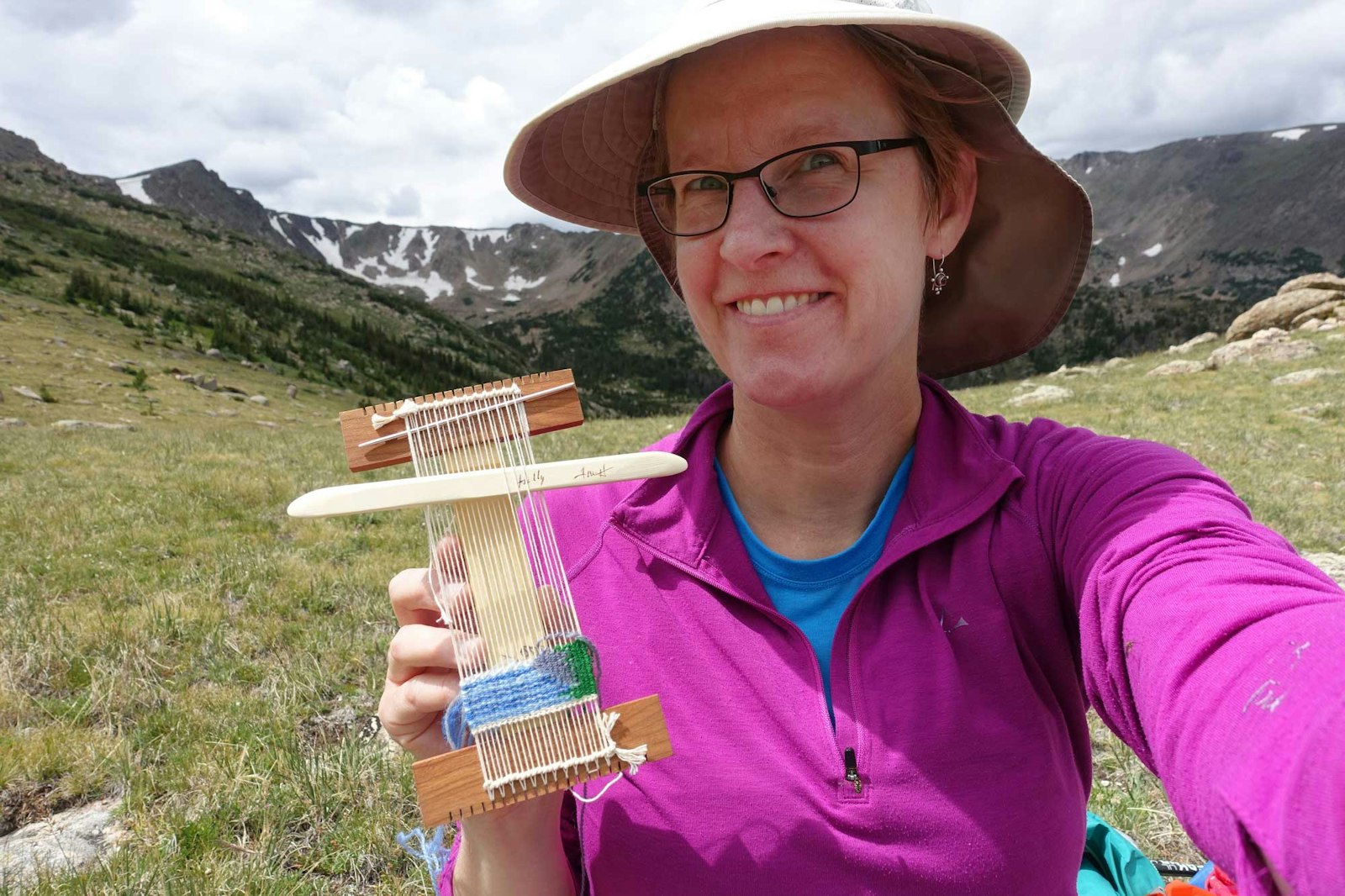
The way I pack my to-go weaving kit depends on where I’m going and what I’m doing. If I’m backpacking, I keep the kit small and light, and typically include a tiny slotted loom, a couple of needles, a shed stick, one small tapestry bobbin, and a tiny tapestry fork. I pack small amounts of cotton seine twine in a couple of sizes for warp. For other types of trips, when I’ll have more luggage or will be traveling by car, I’ll include a larger loom.
How do I choose the amount of weft to bring? When backpacking, I wrap small amounts of weft on pieces of cardboard, or I sometimes spin small amounts of yarn while on the trail with my Turkish spindle from dyed locks or roving. When traveling by car, plane, or train, I augment that collection with some balls or tubes in a variety of colors of tapestry weft.

Rebecca’s travel weaving kit includes a tiny loom, shed stick, tapestry bobbin, and tapestry fork along with some weft and drawing tools.
How to start: Wander and wonder
My sketch tapestry practice is about exploring the world around me. I begin by sticking a small notebook and pen in my backpack and walking with the intention of simply paying attention to what is around me. If an object or scene intrigues me, I make a note about it. If I’m very interested, I’ll sit down and watch and maybe make a sketch. It is so easy to just walk by many objects of interest, such as the pattern created by water in the bottom of an arroyo in New Mexico or the window shapes on the houses in Reykjavík, Iceland. If something catches my eye, it is worth examining a little deeper. I almost always take a photo for later reference, and I know of other weavers who use audio or video recordings, spend time making an in-depth painting of what has caught their interest, or perhaps take a sample of a leaf or stone with them.
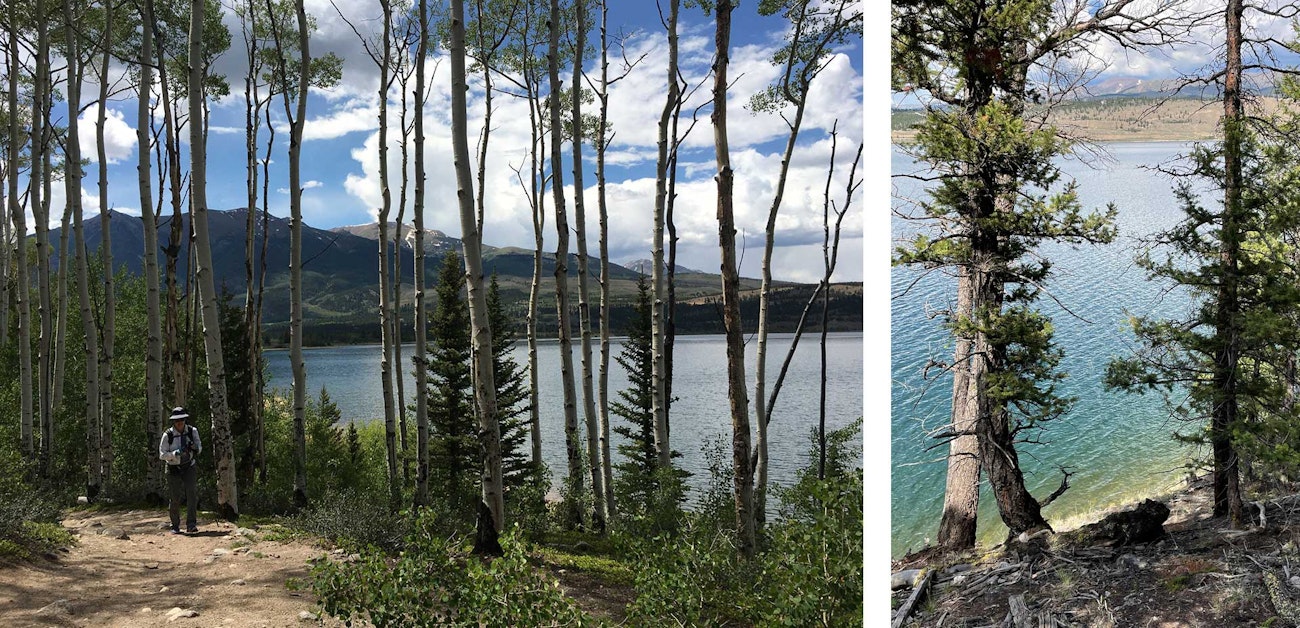
Inspiration for the Twin Lakes sketch tapestry included the walk in the woods and the color of the water below the trail.
How to choose your colors
When I teach this technique in workshops, I always start with color. Color is often the element that grabs our attention first and pulls us in. We can explore the world around us through examining its colors. It can be a lot of fun to try to create a palette in the yarns available that gives the same feeling in what you’re weaving. Notice I didn’t say that I match the colors! It is unlikely that you will have the exact color of the object unless you have an extensive collection of tapestry yarns. I concern myself more with capturing the feeling or essence of something. If the forest I’m looking at is dark and spooky, I can probably create a dark and spooky sketch tapestry with blue instead of green if that is what I have with me.
How do I choose what colors of weft to bring with me in the field? It’s tempting to have all the colors with me, but that is impossible. I usually choose colors I think will match the place I’m visiting. If I’m going to the desert, I’ll bring more browns and deep violets. If I’m going to the forest, I’ll concentrate on green and brown hues. An ideal weft yarn has many color options. I regularly use Gist Yarn’s Array or weaversbazaar wools for this reason. These yarns also come in small put-ups that are great for travel.
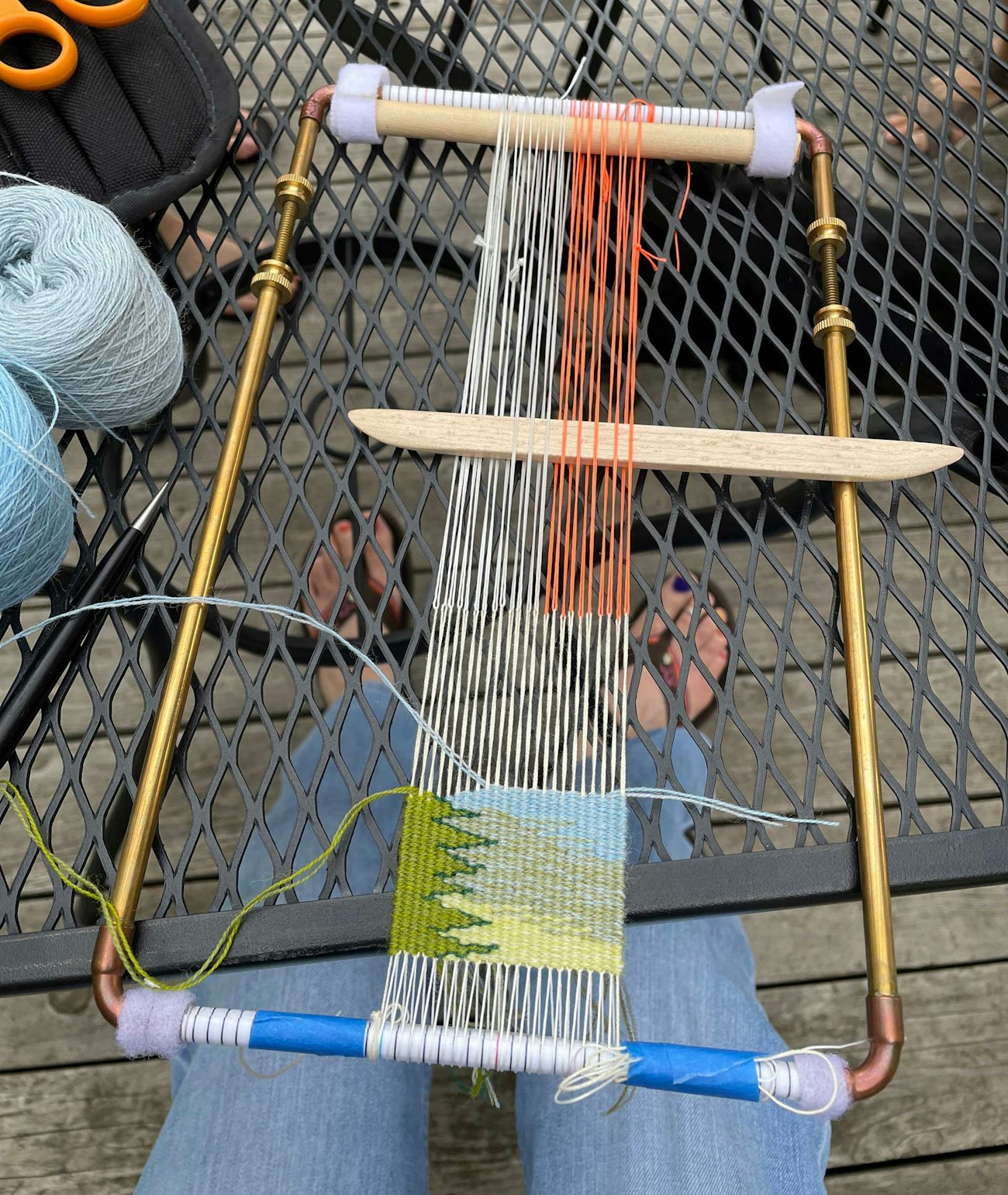
Rebecca wove the Twin Lakes tapestry on a small pipe loom after she got home from the hike.
Simplify
In sketch tapestry, it is likely you will weave at a sett between 6 and 12 ends per inch (epi). That means that making a photorealistic image is impossible. That is good news, because it means you can let go of trying to depict an object realistically and take more creative license with your subject. Forget putting every single detail in your design. It has to be very simple for a tapestry at 8 epi in a small format.
I encourage you to try a few sketch weavings focusing almost entirely on the colors. You can weave stripes, simple squares, or whatever your current tapestry skills allow. Don’t try to weave a landscape complete with trees, water, and mountains in a 2-by-3-inch, 8 epi tapestry! Instead, focus on what colors are part of the scene.
The example photos on page 19 are of a tapestry I wove after taking a hike along the shores of Twin Lakes in Colorado. Looking down at the lake’s edge from the trail, I was interested in how the color of the water went from yellow-green to deep blue as the lake got deeper. The other noteworthy piece of that hike was the joy of walking under a beautiful canopy of pine and aspen trees with friends. I wanted to remember the water color and the presence of the trees.
Yet I did not try to weave water or trees. Rather, I used the color of the water in a gradation on the right side of the tapestry and added green hatches on the left to indicate trees. It is easier to weave that form sideways, and I let the trees continue growing from the side of the image.
The goal is to really look at your inspiration, experience it in a new way, and then translate some of those observations into your work. While you’re weaving, I guarantee you’ll be thinking about your inspiration, and you might have more revelations about your personal relationship to it or your subject in general.
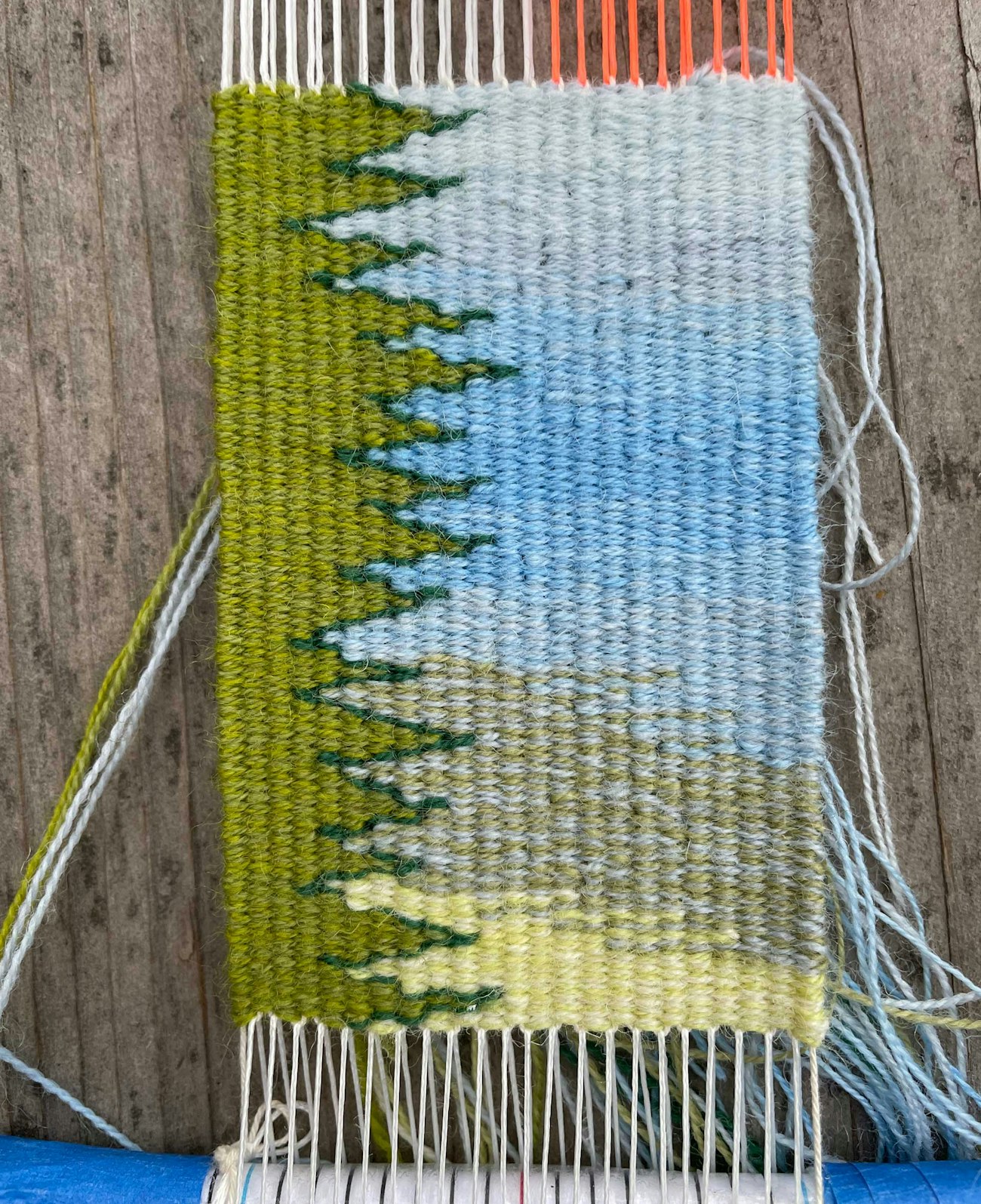
The finished Twin Lakes tapestry is 2" × 3" woven with weaversbazaar 18/2 wool at 12 epi on a fringeless four-selvedge warp.
Your Turn: Weave your own sketch tapestry
Schedule some time to really experience a place. Sit still or walk slowly and look at what is around you. What stands out to you? Are there patterns or colors or forms that you are particularly drawn to? Take time to examine them. This could be a walk in your neighborhood, a hike along a nearby creek, or a two-week trip to Nova Scotia.
Make some notes. You don’t have to actually draw. Words are fine. If you want to capture forms or colors but you’re unsure about your drawing skills, take a photo or two. Just remember that the goal is simplicity. Avoid trying to replicate the photograph in your weaving.
If you feel stuck with what to weave, focus on color. Look at the colors involved and think about whether they are warm or cool and what emotions or feelings they bring up for you, then choose colors that express those feelings.
Weave simple shapes. Choose stripes or squares or simple curves. If you want to include forms from your subject, take out almost all of the information that exists in a photograph of it. Choose one or two shapes to weave and then go back to the colors.
Finish your tapestry with knots or a braid so you can save it as a reminder of this experience. I keep my sketch tapestries pinned to a large board in my studio. You might choose to frame all the tapestries you made in a year or maybe put them in a notebook with journal notes about your travels.
However you finish and display your sketch tapestries, make sure to note the date, where you were, materials you used, and what you were thinking when you wove that piece.
Sketch tapestry is a practice. It is an exercise that you do over and over again, making small, quick tapestries that reflect the happenings in your world right now. I find it a wonderful way to keep myself weaving, to practice seeing like an artist/weaver, and to create memories of places I’ve been. The more you weave, the more you learn about yourself, your skills as a weaver, and the world around you. Now go for a wander!
Recommended resources
- Mezoff, Rebecca. The Art of Tapestry Weaving. North Adams, MA: Storey, 2020.
- Rebecca’s blog posts about sketch tapestry: rebeccamezoff.com/diary.
- Scanlin, Tommye McClure. The Nature of Things: Essays of a Tapestry Weaver. Dahlonega, GA: University of North Georgia, 2020.
Rebecca Mezoff is a tapestry weaver, teacher, and author of The Art of Tapestry Weaving. Follow her at rebeccamezoff.com