
A few years ago, I was staying with Rocky Mountain Weavers Guild member Judy Lepthium, who has since become a cherished friend, and I noticed a cartoon on her fridge. It is a rare thing to see weaving mentioned in any form of popular media, and I can’t find a source online to ask about permission to reprint, so I’ll describe it here: A policeman has pulled an elderly lady over who can be seen behind the wheel with knitting needles flying. He says, “I didn’t know you were knitting, Ma’am. I thought you were weaving!”
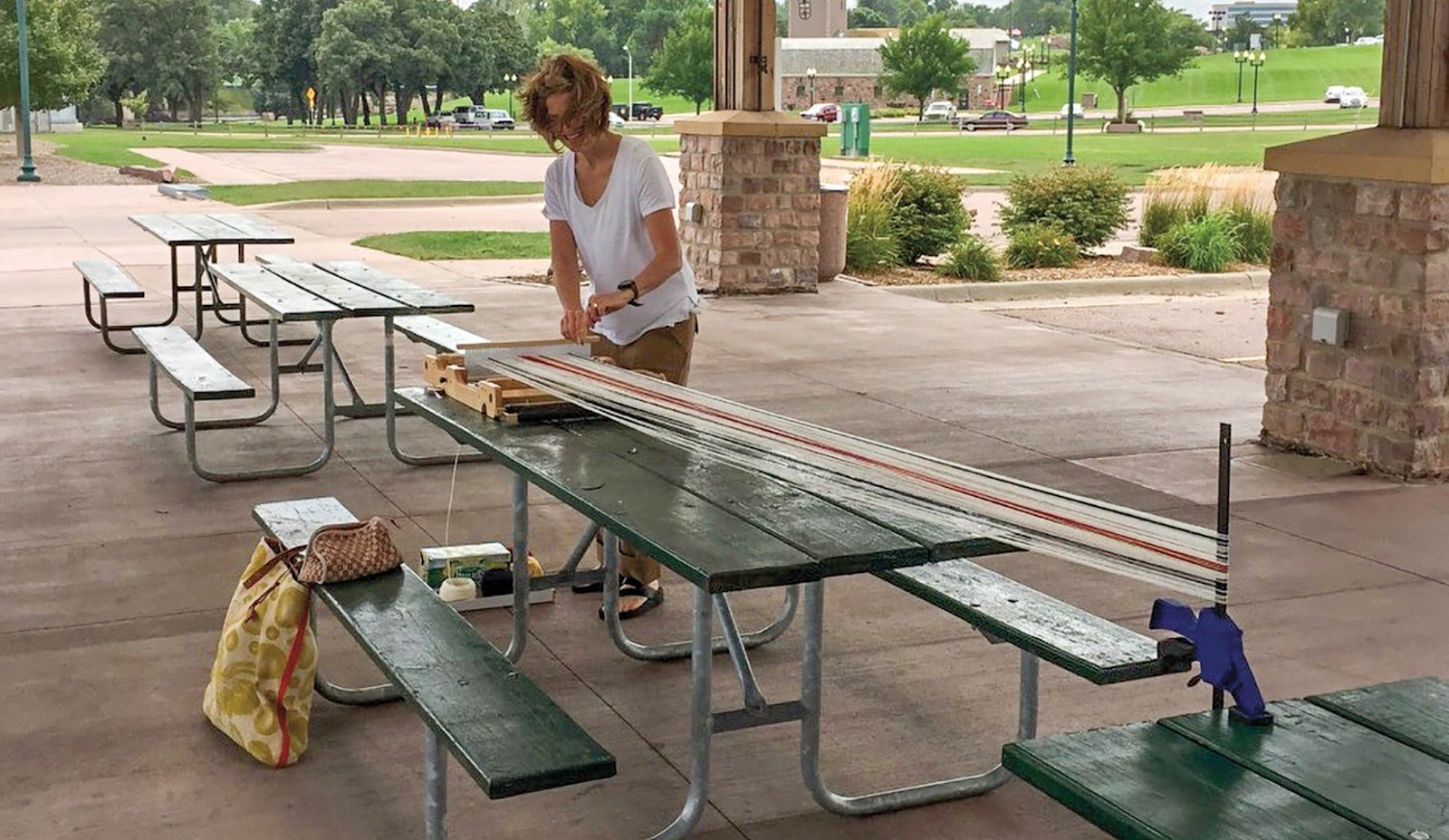
While I would not recommend doing any loom weaving while driving (or while being driven for that matter), I do recommend bringing your rigid-heddle loom with you on the road for weaving during pit stops and any down time you might have at various hotels, motels, and campgrounds along the way. One of the great qualities of the rigid-heddle loom is its portability. Additionally, armed with only a single tote bag’s worth of equipment, you can successfully warp a rigid-heddle loom at parks, motels, and anywhere else you might find a sufficiently long rectangular picnic table.
I confirmed the truth of these assertions early last fall when my husband and I embarked on a cross-country drive after our youngest son flew off to college; we were heading to a workshop I was teaching for the Whidbey Weavers Guild in Washington. I live in Massachusetts, so it was truly a coast-to-coast adventure.
I had two rigid-heddle looms with me for our trip, one with a deadline project on it and the other for impromptu weaving. We had decided ahead of time that we would set a general route heading northwest and planned on taking about 12 days to get across the country. I had a secret agenda, though. While my husband searched for historic or scenic sites (including cultural must-sees such as the Jolly Green Giant in Blue Earth, Minnesota, and the Corn Palace in Mitchell, South Dakota), I would look at his proposed route and search for fiber/yarn destinations that were my real goals. Having my rigid-heddle looms with me on our trip was perfect because if I wanted to visit, say, Blue Boxer Arts in Eau Claire, Wisconsin, or the Faribault Mill in Minnesota, my husband might have a counterproposal for a site or route, but because I was constantly weaving off projects, I “needed” to stop for more yarn.
 Accessorizing Malcolm C. Story with a handwoven scarf in Bozeman, Montana.
This “necessity” required that we find and visit mills and yarn stores at almost every stop. Sometimes the yarn store detours took us to vibrant towns and cities that we might not have visited otherwise. We did the same thing on the route home; this time, we tried to buy yarn from every state we traversed, stopping at Knot Another Hat in Hood River, Oregon; the magical Needlepoint Joint (a store with a knitting/needlepoint side and a weaving side!) in Ogden, Utah; and many more. We decided that thriving yarn stores and fiber life in general were excellent indicators of vibrant city and town life that often included scenic beauty and memorable food and drink.
Finding places to dress my looms also turned into adventures and opportunities to meet people. We had great conversations—almost always starting with “What are you doing?”—with German bikers at the Rocket Motel in Custer, South Dakota; lunching cops at the state park in Sioux Falls; Route 66 travelers at the Blue Swallow Motel in Tucumcari, New Mexico; and alien seekers in Flatwoods, West Virginia.
For those interested, my mobile weaving tote bag contained bamboo placemats (warp separators), Irwin quick-grip clamps in two sizes to serve as warping pegs, a couple rigid heddles, and my usual kit of scissors, tapestry needles, tape measure, etc. I also had my rigid-heddle stand, which came in handy when long tables were in short supply, as I could clamp my peg on a small table and position my stand with loom at the desired warp-length distance, securing it to a chair or weighting it with suitcases or sometimes, using my husband as anchor—he’s supportive in so many ways!
 Motel weaving in Bozeman, Montana.
I now have quite a few “state” scarves, often woven with fiber from the state I wove in, but more importantly, holding memories of the awesome (in the old sense) beauty and variety of our country and the unfailing openhearted kindness of the people we met, and the knowledge that the fabric of my life is infinitely enriched by weaving.