

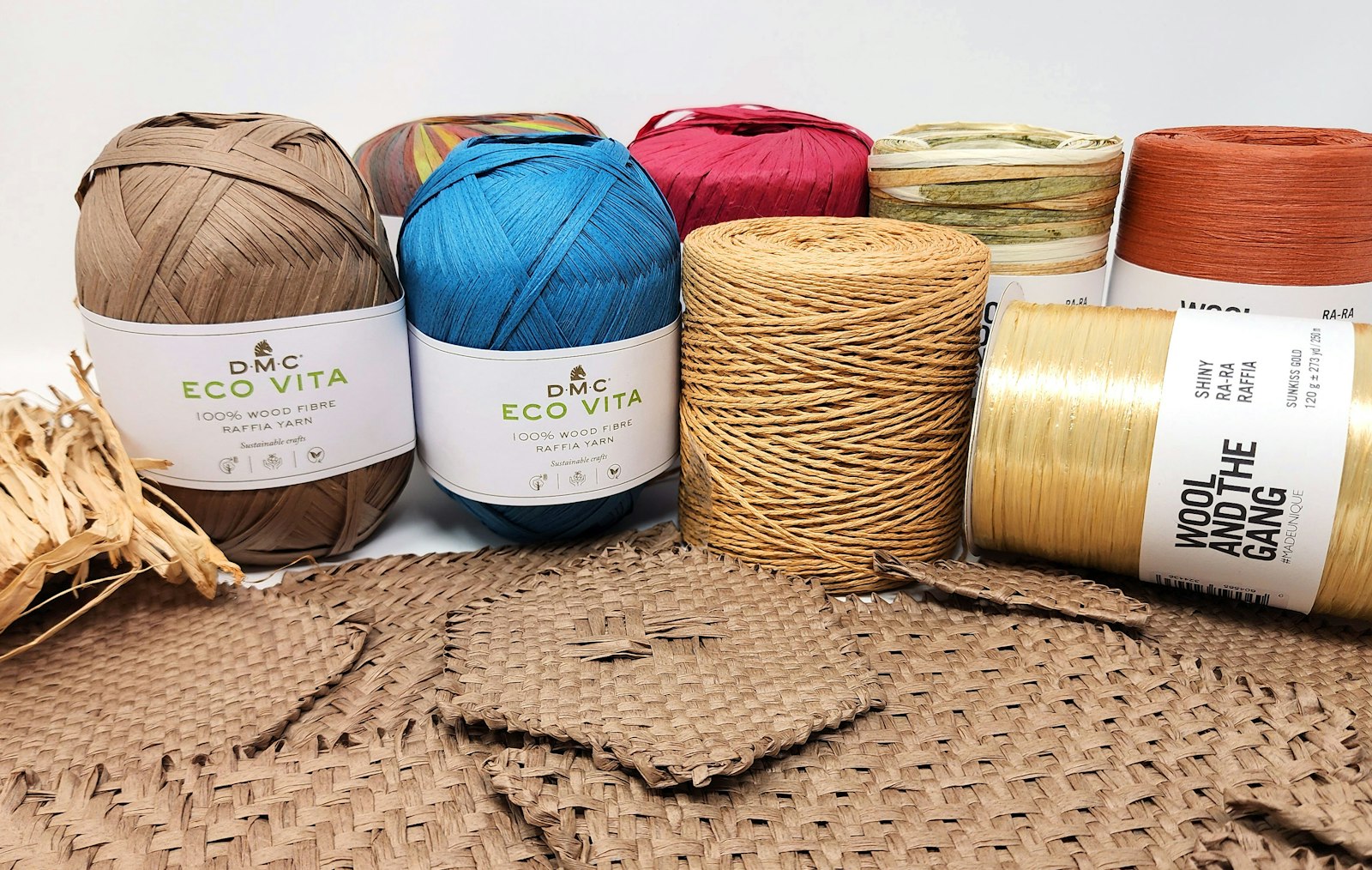
Weaving with raffia can be a challenge, but oh, the results are worth the extra effort. Not only is raffia durable, water resistant, and heat resistant, but it also is a wonderul foundation for woven patterns and pick-up. Even the smallest of motifs shine brightly when woven in raffia. Over the years, I’ve developed some tips and tricks that make working with raffia on the pin loom much easier. Of course, before we can weave with raffia, we need to understand the fiber and know how to choose the right yarn for our weaving.
Choosing Yarns
There are two main categories of raffia—natural raffia and manufactured raffia—and which one you choose can make a big difference in your pin-loom weaving.
Natural raffia is made from fibers harvested from the leaves of the Raphia farinifera, a palm tree native to southern Africa, particularly Madagascar. While using natural raffia for pin-loom weaving isn’t impossible, it can be tedious. The fibers used to make natural-raffia yarn are not continuous, but instead are the length of the palm leaf they were harvested from. Also, the thickness of natural-fiber raffia varies significantly, and while natural-raffia yarns are strong and bendable, weaving with them requires coordination and patience.
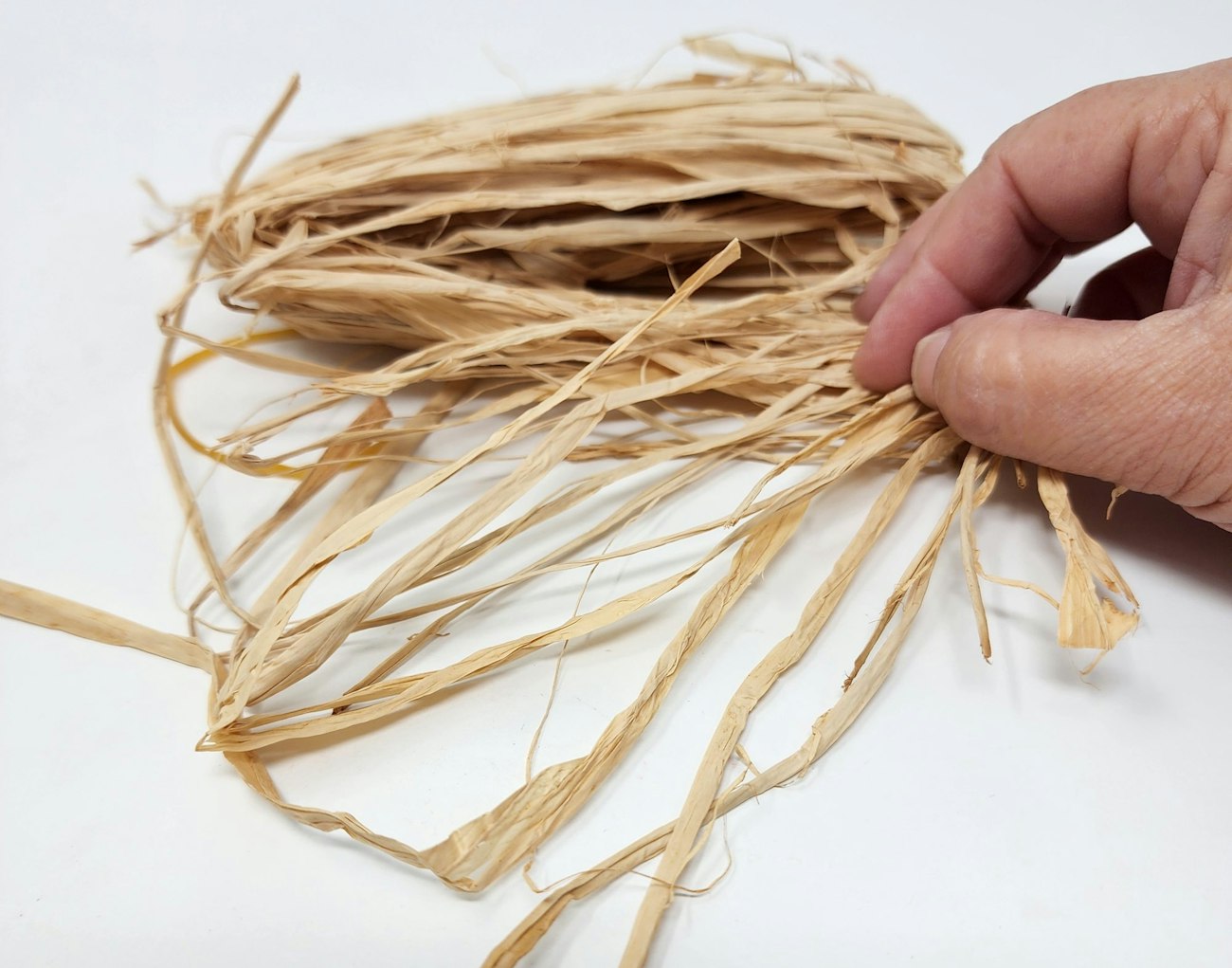 Natural raffia, as in the example shown here, usually has an uneven texture, which can make weaving difficult.
I prefer to weave with manufactured raffia. These yarns are typically made from 100% wood pulp and come as a continuous, evenly wide strand of smooth fiber. These types of raffia yarns are also available in a broad variety of colors and twists, so you have more options when it comes to choosing the right yarn for your weaving project. When choosing a manufactured-raffia yarn, look for ones designed for crochet and knitting. While raffia made for wrapping presents might look pretty tied in a bow, it also might not be strong enough to use in your weaving. Raffia yarns made for fiber artists are usually more durable and flexible than other raffia options.
 For her raffia Hexie Knot Mat from Summer 2026, Gabi used a manufactured raffia and used two different patterns to weave her shapes: a twill for the jewel pieces and a simple pick-up motif for the hexagons.
Test for Quality
Always test a new raffia yarn before you weave with it. Raffia yarns aren’t all created equal. Low-quality yarns may easily split or tear during weaving. You can check the quality of your raffia yarn with a few simple tests.
Test for strength. Start by sliding the yarn over your finger to test its strength. Good weaving raffia should slide smoothly and adjust to bending without resistance. If the raffia cracks or breaks easily, it’s not a good option for weaving. Next, unroll the raffia to its full width for a few inches and look for cracks along the edges and rips within the fiber—it should be solid and smooth and not separate easily.
 After testing your raffia yarn for strength, unroll it for a few inches and inspect for any tears or cracks. This raffia yarn has no rips, so should hold up well to the stress of weaving.
Test the dye. Raffia yarns are available in a wide variety of bright and beautiful colors—but not all brands of raffia are colorfast. If you’re planning to make a trivet for your table, you want to make sure the fabric won’t bleed dye as soon as it gets wet. To test for colorfastness, cut off a short piece of the raffia and place it on a paper towel. Gently massage water and soap into the raffia and let it dry. The paper towel should be clean when you take off the raffia piece.
 Some raffia yarns tend to bleed dye when they get wet, so it’s important to test for colorfastness. You can still use raffia yarns that aren’t colorfast, but if you’re using them to make projects that will get wet—such as mug rugs or trivets—you’ll want to line them with something to prevent the dye from migrating to your table.
When in doubt, you can always use the raffia in a mixed-fiber project. If you think you’re not ready for a “raffia-only” project or are worried about the quality of your raffia yarn, consider pairing it with other weaving materials including more traditional yarns, string, and even jewelry wire.
Tips for Weaving with Raffia
Once you’ve chosen and tested your yarn, it’s time to get started weaving. Here are a few tips, tricks, and recommendations to make weaving with raffia as smooth and easy as possible.
Stick to smaller looms. Because the raffia is inelastic, you need to keep it loose as you weave; however, if the raffia is too loose, it can also cause problems. For example, raffia that’s too loose is more likely to pop off the pins during weaving and can make it more difficult to follow the correct weaving path. Larger looms require looser weaves—even when using traditional weaving yarns—so a small loom is your best choice for weaving with raffia when you’re first starting out.
Use a hair elastic or rubber band to secure your weaving. To keep the slippery raffia from popping off your loom, place a hair elastic or rubber band around some of the pins on your loom. This will act as a barrier to keep your weaving in place. You can see an example in the photo below.
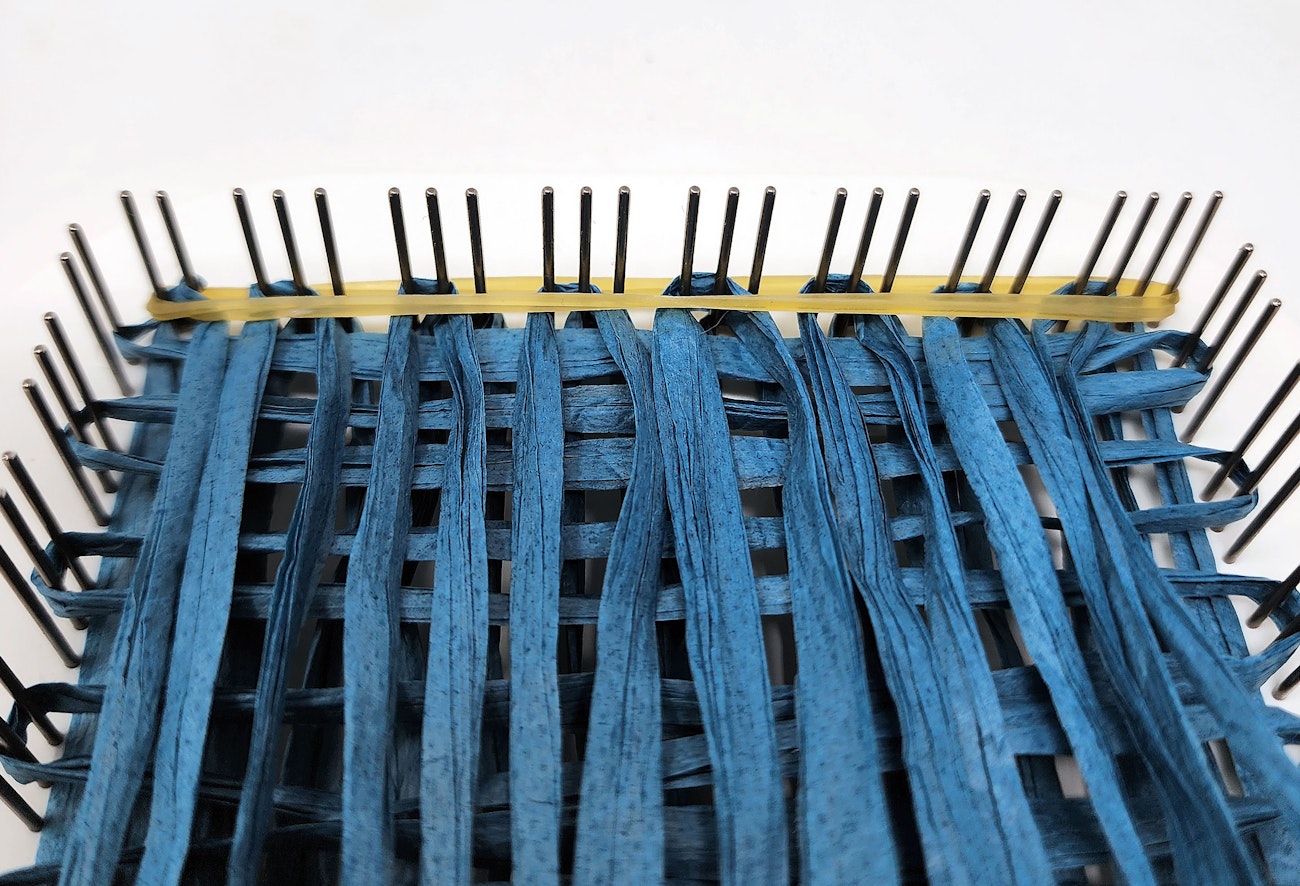 To keep your raffia from popping off during weaving, use a rubber band around some of the pins to act as a barrier.
Pack your weaving frequently to ensure the best tension distribution. Once you start weaving, use a dull tool such as the back of a hook or the small end of a spoon to move your raffia into place. Don’t use a comb or fork because these tools might split the raffia.
Weave each new row close to the previous one. Loose raffia warp strands have a tendency to mix together and can make it difficult to see whether you’re weaving in the right place. By staying close to the row you just wove, it’s much easier to find and follow the correct path.
Take your time. The key to weaving with raffia is patience. Don’t expect it to be a speedy process; instead, use it as an opportunity to slow down and focus on the process of weaving. A mixed-fiber approach is also a good option if your pin loom isn’t designed for thicker fibers, as raffia typically compares to heavy worsted weight.
 In this square, Gabi used the raffia for layers 1—3, then wove the last layer with a more traditional yarn.
Finishing and Washing Your Weaving
When you’re done weaving each raffia pin-loom piece, weave the tails back into the fabric and let them stick out on the wrong side for about ½ inch. Clip them short after wet-finishing to prevent them from worming out. After you take a woven piece off the loom, you will see that the raffia edgings stay loopy. I consider this a special bonus of weaving with raffia because it makes joining easier, and it invites you to embellish the edgings with pretty borders.
If your raffia yarn is good quality, you can wash and wet-finish it. I like to wet-finish my raffia projects by soaking the item in cold water mixed with a nonrinse soap (I use Eucalan) for about 20 minutes. When the time is up, remove the item and let the water drip off—do not wring it. Press out excess water between towels, then lay the item flat to dry. I have experienced that, besides getting clean, the raffia settles nicely, which smooths the weaving and the seams. You can repeat the process whenever you need to clean your item.
For raffia-yarn projects that are less durable or colorfast, you can skip wet-finishing and instead spot-clean when needed. Some weavers prefer to hold their raffia items under cold running water while sponging them off with a gentle soap before rinsing. When in doubt, sample! Weave a piece in each color that you plan to use for your project and block it the way you intend to use the finished project. This minimizes the chance of losing the whole project in case something doesn’t work out as expected.
Editor’s Note: Looking for a good project to get you started on your raffia weaving journey?
Try weaving Gabi’s Hexie Knot Mat from the Summer 2026 issue.
For a mixed-fiber project, check out Margaret Stump’s Patio Party Mats from Summer 2023. They use a combination of elastic yarns and raffia, making for an easier first-raffia-weaving experience.