

Contents
Before heading out on a month-long trip to visit family, Alison Irwin had the idea to try to build a small loom that could fit in a carry-on bag. She packed a picture frame, some thread, and a small bag of thrums before heading out to see her grandchildren. Using her frame and thread, as well as some items from her grandkids’ craft supplies, she built a small, Salish-style tapestry loom. In her article "Building a Loom from Memory,” Alison details how she built her loom and wove her first project on it.
Not only is Alison’s loom completely functional, it’s a perfect travel loom. It can be made as small as you’d like, so you can build it to fit in a standard carry-on bag or even a purse. The supplies used to build the loom are easy to find and fairly inexpensive, so if the loom gets lost during your travels, it won’t be as devasting—and if it breaks, you can easily fix it or build a new one. (For that same reason, this loom is also great for weaving with small children who don’t know their own strength.)
Interested in building your own travel tapestry loom? Keep reading for all the details on how to build and warp your own loom using Alison’s method.
 Alison’s travel loom and the first project she wove on it. Photos by Alison Irwin except where noted
Constructing the Loom
Supplies
- Picture frame with glass removed
- Pencil or small dowel, slightly longer than the width of the picture frame—hexagonal pencils and square dowels work better than round ones.
- Tapestry warp thread
- Size 6/0 seed beads
- Narrow cardstock rectangle cut slightly wider than your desired warp width
Loom Building Instructions
- Step 1. Working on the back of your frame, measure the width of the picture frame and mark the center on both the top and bottom panels. Measure the height of your picture frame and mark the center on both panels.
- Step 2. Measure the length of your pencil or dowel and mark the center.
 Firmly tie down only one end of the pencil or dowel rod.
- Step 3. Place your pencil or dowel across the back of your frame at the marked center points on the side panels. Align the pencil or dowel’s center points with the center points marked on the top and bottom of the frame. Using the warp thread, securely tie the pencil or dowel across the back of the picture frame, see photo above. This will be used as the rod around which a continuous warp changes direction.
 Tie a large knot under the other side of the pencil or dowel to anchor it in place while also leaving it open.
- Step 4. On the other side of the rod, tie a large knot under it, see photo above. The knot will anchor it in place while still allowing you to wrap threads around it as you dress the loom.
Dressing the Loom
- Step 1. Thread seed beads onto your cotton or linen thread. The size 6/0 seed beads will be used as warp spacers and you’ll need 15-17 per inch, depending on your warp thread and the length of your seed beads. For example, if you want a 2" warp, thread 34 beads; excess beads can be removed later. Move the beads down the thread a distance of at least four times the height of your frame.
- Step 2. Beginning on the back of the frame, tie the thread with a slipknot near the anchored end of the rod, and then carry it over the top of the frame.
- Step 3. Take one seed bead and bring it to the top of the loom. Carry the thread down the front and around the bottom of the loom. Adjust the seed bead as needed so it remains on top of the loom.
- Step 4. Take another seed bead and place it on the bottom of the loom. Carry the thread around the bottom of the loom and back up to the rod. Adjust the seed beads if needed.
- Step 5. Loop the thread over the rod’s free end and reverse direction, going down the back, up the front, and over the back to the rod, adding seed beads to the bottom and top of the loom as you did in Steps 3 and 4.
- Step 6. Repeat Steps 2–5 until the warp is your desired width. On your last round, cut your warp thread, remove any excess seed beads, and tie the warp securely to the rod.
- Step 7. Your warp will have two layers: An active warp on the front and an inactive warp on the back. Turn the loom right-side-up and open a plain-weave shed in the top layer of the warp. Insert a narrow strip of cardstock in the shed and place it at the bottom of the loom.
Weaving and Finishing
To begin weaving, start with a few picks of your warp thread. Alison finds it helpful to separate her warp layers by slipping a piece of paper or cardstock between the front/active and back/inactive warps. (Tip: If you use a color of paper or cardstock that contrasts with your warp, it can make it easier to see each warp end.)
Have fun weaving on your new loom! The small size makes it perfect for using up thrums and other small bits of yarn. Use it to try out different tapestry techniques and color combinations. Try adding beads or other embellishments to the warp or weft. Finish each piece with a few picks of the warp thread as you did at the start.
When you’re done, remove the fabric by first slipping the warp loops off the rod. Using a tapestry or sewing needle, sew any weft ends back into the cloth and trim. Cut the warp loops and remove the seed beads from one side of the fabric. Secure the weft however you’d like—sew in the fringe ends, knot the fringe, twist the fringe, etc.—and then repeat on the other end of the fabric.
More Resources
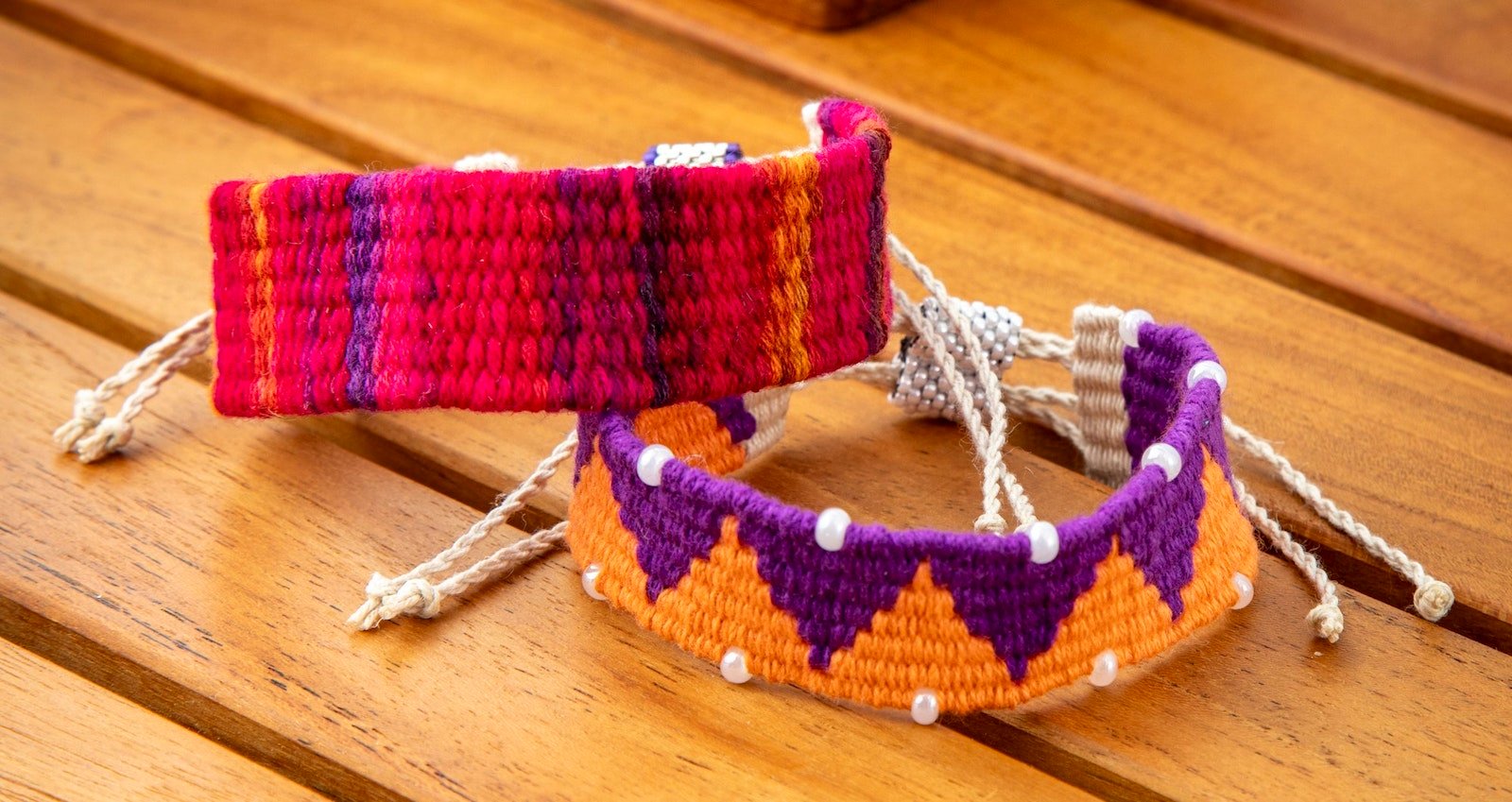
To find more ideas on how you can modify your new picture-frame loom as well as two bracelet projects, check out the Winter 2025 issue of Easy Weaving with Little Looms. In her article starting on page 26, you’ll learn the changes Alison made on her second picture-frame loom as well as how she chose and used her weft yarns.
After you’ve read her article, make sure to check out her Traveling Tapestry Cuffs project and learn how to weave two gorgeous bracelets on your brand-new loom.
Happy Weaving!
Christina