

Contents
- The 7 Terms Every Weaver Needs to Know
- Glossary of Weaving Terms and Phrases
- Balanced Weave
- Beaming
- Beat or Beating
- Cross
- Dent
- Direct Warping
- Draw-In
- Dressing the Loom
- End or Warp End
- Ends per Inch (EPI)
- Fell or Fell Line
- Float
- Indirect Warping
- Loom Waste
- Pick
- Picks per Inch (PPI)
- Plain Weave
- Selvedges
- Sett
- Shed
- Strand
- Tabby
- Take-Up
- Thread (verb)
- Thread (noun)
- Warp
- Warp-Faced or Warp-Dominant
- Warping
- Weft
- Weft-Faced or Weft-Dominant
- Wet-Finishing
- Rigid-Heddle Loom Parts and Locations
- Next Steps and Resources
As with any art or craft, weaving has a vocabulary all its own. When you’re a new weaver, it can be confusing reading weaving articles or projects that throw out terms such as warp, weft, and sett if you don’t know what they mean. To make the learning process easier, we’ve created this list of common weaving terms and their definitions. You can read through the entire list, or you can use the menu to jump straight to a specific word.
The 7 Terms Every Weaver Needs to Know
When you first start learning to weave, these are the terms you absolutely have to know. With some of these terms, you need to know the definition of other terms first. So, instead of listing these words in alphabetical order, we present these important weaving terms with the simplest at the top and the slightly more complex at the bottom. We’ve kept the definitions here as simple as possible. You can find more in-depth definitions in the Glossary of Weaving Terms and Phrases below.
Warp
The strands of yarn or thread that are tied onto the loom and moved up and down are collectively known as the warp. Individual warp strands are referred to as warp ends.
Warping
The process of attaching, arranging, and tensioning the warp threads on your loom.
Weft
The thread that goes over and under each warp end is the weft. One row of weft is called a pick.
Selvedges (aka your edges)
The outermost side edges of your weaving.
Sett
The number of either warp ends or weft picks per inch that are in your weaving. Warp sett is referred to as ends per inch (EPI), and the weft sett is referred to as picks per inch (PPI).
Dent
The openings in the heddle where the warp yarns are placed during warping. On a rigid heddle, the dents are made up of alternating slots and holes. A heddle’s sett is the same as the number of dents per inch: A heddle with 8 slots and holes per inch would be an 8-dent heddle.
Shed
The tunnel of warp ends that is created when you lift or lower the heddle and through which you send your shuttle.
Glossary of Weaving Terms and Phrases
These are some of the most-common weaving terms and phrases you’ll see in any weaving book, magazine, article, or project. We’ve listed these words in alphabetical order. For some of these terms, you’ll also see links to resources with more information.
Balanced Weave
When a fabric has the same number of warp ends per inch (EPI) and weft picks per inch (PPI). Also called a balanced sett or balanced fabric.
Beaming
The process of winding your warp onto your back beam before weaving. Beaming is a part of the warping process.
Beat or Beating
The proces of using the heddle, shuttle, or other tool to push the weft into place after weaving each pick. How hard or soft you beat will affect your picks per inch (PPI). Some types of cloth, such as lace, require a very soft beat while others, such as weft-faced fabrics, require a much harder beat.
Cross
In indirect warping, the warp threads are ordered and measured by winding them on a warping board or warping reel. The cross is a figure eight made at one or both sides of the warp during winding. It helps to keep the warp threads from tangling and keeps the yarn in threading order as you thread your heddle.
 A weaving cross, like the one shown here on a warping board, is made at one or both ends of a warp during winding. It is used to help keep the warp ends in order during threading.
Dent
The openings in the heddle where the warp yarns are placed during warping. On a rigid heddle, the dents are made up of alternating slots and holes. A heddle’s sett is the same as the number of dents per inch: A heddle with 8 slots and holes per inch would be an 8-dent heddle.
Direct Warping
A method for warping a rigid-heddle loom where warp threads are measured and at least partially threaded before beaming. For more information about direct warping, including a step-by-step instructional video, see “Rigid-Heddle Basics: Direct Warping Your Loom.”
Draw-In
The amount that the back-and-forth of the weft pulls the fabric in, making it narrower.
Dressing the Loom
Another term to describe warping the loom.
End or Warp End
A single unit of warp passing from the back to the front of the loom. Each warp end is threaded through its own dent in the heddle. An end can be a single thread or multiple threads used together and threaded through the same dent in the heddle.
Ends per Inch (EPI)
The number of warp ends in an inch as measured across the width of the warp. The ends per inch is also known as the warp sett.
Fell or Fell Line
The front edge of the cloth as it’s being woven on the loom. Where the unwoven warp meets the most recently woven pick marks the start of the fell line. As the fell line gets closer to the heddle during weaving, the shed in turn becomes narrower. To move the fell line, tension is released from the loom, and the woven cloth is wound onto the front apron rod. Moving the fell line is often called advancing the fell line or advancing the warp.
 Where your unwoven warp meets your most-recently woven weft is the fell line. Photo by George Boe
Float
When a weft goes over or under more than one warp thread it creates a float, a small area of texture that seems to “float” over the rest of the weaving. Floats can be intentional or accidental. Going over more than one warp end creates a warp float (a line of texture that goes up and down), and going under more than one warp end creates a weft float (a line of texture that goes from side to side). Warp ends on the front of the fabric will show as weft ends on the back, and vice versa. For information about preventing unwanted floats and how to fix them when they occur, see “How to Fix Unwanted Floats in Your Weaving.”
 Floats, like the ones shown here in the Stepping Stones Scarf by Tammy Bast, are created when the weft goes over or under more than one warp end. They can be intentional or accidental. Photo by Matt Graves
Indirect Warping
A method for warping your loom where the warp ends are ordered and measured on a warping board or warping reel before being transferred to the loom. For more information about indirect warping and when to use it instead of direct warping, see “Indirect Warping for Longer Warps with Fewer Tangles.”
Loom Waste
The length of warp that cannot be woven, including the length needed to tie the warp onto the loom. After weaving, loom waste can be cut off or used as fringe. Different looms require different amounts of loom waste.
Pick
A pick is a single pass of the weft through a shed. It is also sometimes called a shot. A pick can be a single strand or multiple strands wound together on the same shuttle.
Picks per Inch (PPI)
The number of weft picks in an inch of weaving as measured from top to bottom. Picks per inch is also referred to as the weft sett. Different elements affect your PPI, including the size of your weft yarn, how hard or soft you beat each pick, and the consistency of your beat.
Plain Weave
The simplest form of weaving where the weft alternates going over one and under one warp end for the width of the warp. Sometimes referred to as tabby.
Selvedges
The outermost side edges of your weaving where your weft travels to and from each pick. As you weave, your weft warps around the selvedges. Sometimes spelled selvege or selvage.
Sett
The sett refers to how many warp ends per inch (EPI) or weft picks per inch (PPI) are in your weaving. The heddle controls the warp sett while yarn size and beat strength both play a part in the weft sett. A balanced sett refers to cloth with the same number of warp ends as weft picks per inch.
Shed
The tunnel of warp ends created when you lift or lower the heddle. You send your shuttle through the shed as you weave. Changing your shed changes which warp ends are on the top and which are on the bottom.
Strand
A single piece of yarn or thread. Multiple strands can be warped together as a single warp end or wound together on the same shuttle to make a single weft. Sometimes also referred to as a thread.
Tabby
Another word used to refer to plain weave.
Take-Up
The amount of yarn used to pass over and under other yarns (in addition to the amount of yarn used to travel in a straight line).
Thread (verb)
To arrange your warp ends in the dents of your heddle. Sometimes also called sley.
Thread (noun)
Another term used to refer to a single piece of yarn or thread. Multiple threads can be warped togetehr as a single warp end or wound together on the same shuttle to make a single weft. Also referred to as a strand.
Warp
The strands that are tied onto the loom and through the heddle are collectively known as the warp. The warp moves up and down as you weave. The individual units of warp that are threaded through the dents of a heddle are called warp ends. Warp ends can be made up of one strand or multiple strands working as one.
 The warp refers to the strands that are tied onto the loom and threaded through the heddle. Photo courtesy of Long Thread Media
Warp-Faced or Warp-Dominant
A finished fabric where only the warp is visibile on the face of the cloth is referred to as warp-faced. Some fabrics show a small amount of weft through the warp; those are called warp-dominant.
Warping
The process of attaching, arranging, and tensioning the warp ends on your loom. It includes measuring the warp, tying the warp onto the loom, sleying the heddle, winding the warp onto the warp beams, and tensioning the warp before weaving.
Weft
The yarn that goes over and under each warp end is the weft. While the heddle and loom control the warp, the weaver controls the weft. One row of weft is known as a pick.
Weft-Faced or Weft-Dominant
A finished fabric where only the weft is visible on the face of the cloth is referred to as weft-faced. Fabrics that show a small amount of warp through the weft are called weft-dominant.
Wet-Finishing
Processing the woven fabric in water, often with a mild detergent, to help the yarn settle into place and the fabric become more cohesive.
Rigid-Heddle Loom Parts and Locations
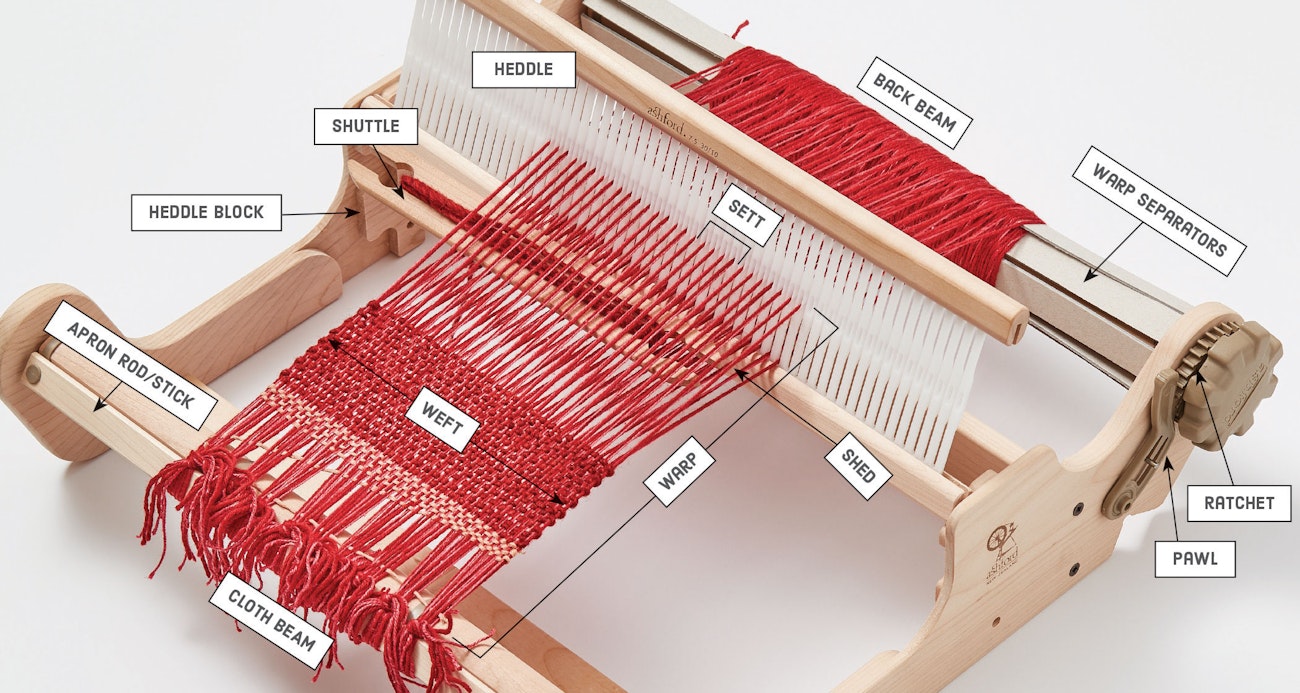
Use the photo below as a quick reference on the different parts of a rigid-heddle loom and their location. While the appearance and location of each loom part might vary slightly depending on your loom’s make and model, each part should be in roughly the same place. Some looms might have extra parts or equipment. When in doubt, refer to manufacturer’s paperwork for your specific loom model. For more information about the parts of the loom and the roles they play in the weaving process—including a video tour of a rigid-heddle loom—see our handy reference “Rigid-Heddle Basics: Parts of a Rigid-Heddle Loom”
Next Steps and Resources
Learn how to confidently warp and weave on your rigid-heddle loom with Sara C. Bixler’s video course Beginning Weaving on the Rigid-Heddle Loom. Sara covers choosing yarns, warping, weaving best practices, basic weaving designs, and much more.