

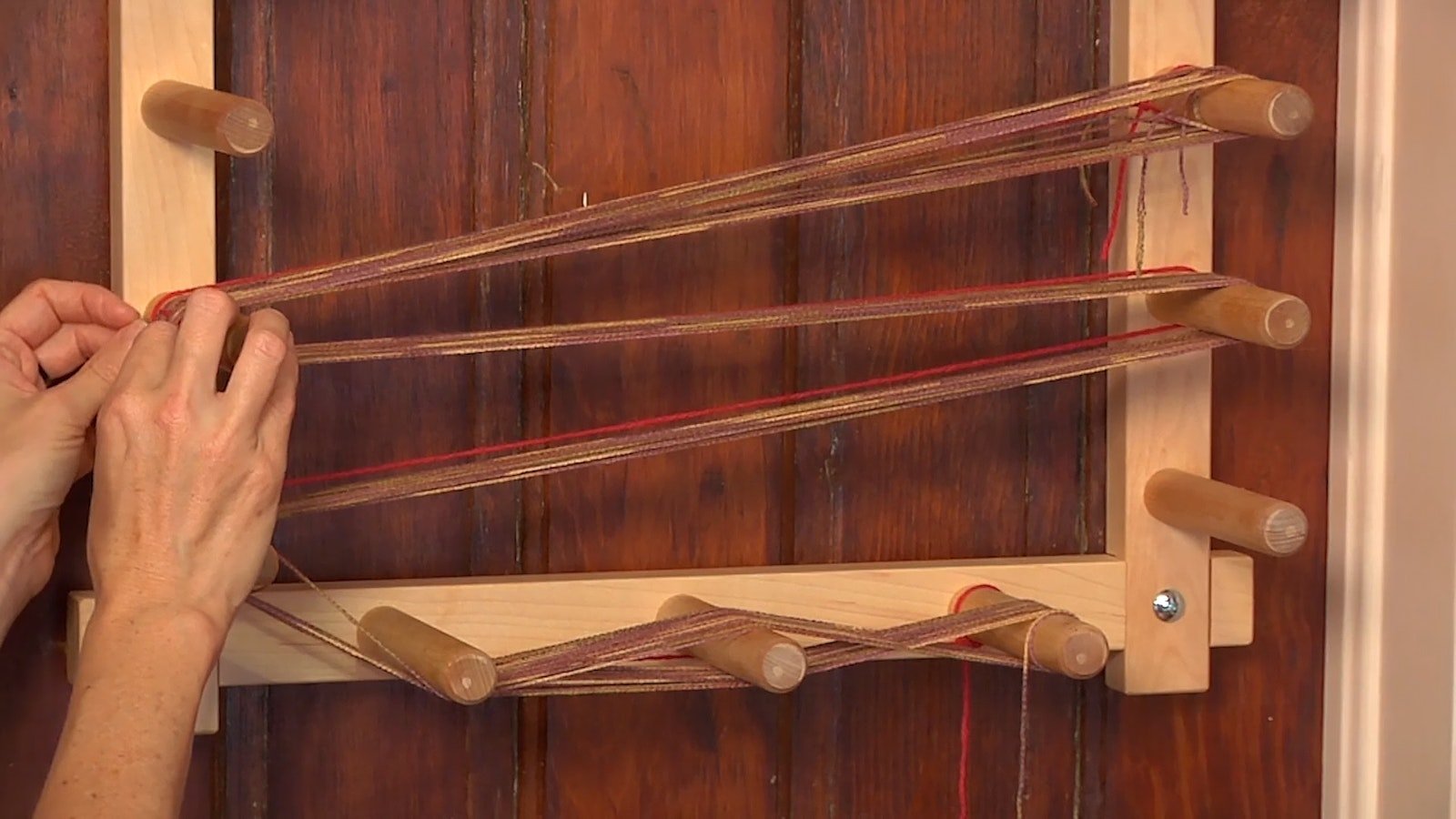
When I started weaving on my little rigid-heddle loom it was love at first warp. I was amazed at how quickly and easily I could get everything measured and threaded with my little warping peg. Simply clamp down the loom on the table, clamp the peg on a bookshelf, and in around thirty minutes I was ready to weave. Direct warping was so quick and easy, I couldn't imagine warping any other way!
At the time, I'd only woven solid-colored warps and warps with chunky stripes. I soon found out warps with frequent color changes were a completely different story. When I tried warping the loom for log cabin pieces it would get fiddly. Because I had to change colors every other end or so, I couldn't cut and tie-on whatever color wasn't in use. As a result, the warp threads would tangle on each other by the apron rod, and I found myself having to frequently intervene to keep things orderly.
Longer warps also posed a problem. With direct warping, your warp length is determined by the distance of your peg to the back apron rod of your loom. When I was first weaving, I lived in a small house with equally small rooms, which severely limited how much warp I could put on for any given project. Eventually I grew tired of untangling my short warps and found myself wanting more.
The only solution to my problem, I realized, was to learn how to use a warping board. To me, a very beginning weaver, using a warping board was intimidating. There were calculations, mysterious pegs, and ominous sounding terms like "choke" and "cross." As it turns out, I had nothing to fear. All it took was a little confidence, the right yarn, and Liz Gipson.
 Liz Gipson will teach you how easy it is to warp your rigid-heddle loom. Photo courtesy of Long Thread Media
Liz's video Slots and Holes: Three Ways to Warp a Rigid-Heddle Loom helped me to stop worrying—and start warping. In her video, she covers not just indirect warping, but also direct warping and how to warp two heddles. She goes over not just the steps of each technique, but also when and why you might choose one over the other, as well as a bunch of great tips and techniques to make each method even easier. After watching the video, I wound my warp on a warping board and dressed my rigid-heddle loom without issue.
Now, that was over ten years ago. Since that time, I've learned quite a bit more about warping. Being able to confidently warp my loom using multiple methods has helped me so much as a weaver—instead of having to rely on one or the other, I can choose which method best fits my project. While direct warping is quick and easy—and I do love being able to design warps on the loom—indirect warping has many benefits.
Benefits of Indirect Warping
- Warp length isn't limited by where you can position your warping peg in relation to your loom.
- It's easy to stop winding and move your warping board to another room.
- Direct warping takes up a lot of space, and leaving a warp untended for an extended period can be inconvenient (especially if it goes across your dining room table). With a warping board, you can stop winding at any point and return days or even weeks later without it causing logistical issues.
- It's easier to keep small children and cats away from your warp if it's on a warping board.
- If you're using a warp yarn with color changes, you can have better control over how those color changes line up in your warp with a warping board.
- For projects with complicated warp color orders you can simply wind the yarn in order and transfer them to the loom—no carefully counting dents as you move ends around.
- You can remove the heddle from the loom for easier and more ergonomic threading.
 Liz shows you how to thread your heddle off the loom for more a more enjoyable threading experience. Once the slots and holes are threaded, the heddle can be easily transferred back to the loom.
I highly recommend that all rigid-heddle weavers learn how to use a warping board along with the indirect warping method. Even if you use direct warping most of the time, there will probably come a day where you realize (like me) that using a warping board will make your life so much easier. Also, if you expand your weaving to multi-shaft looms, already knowing how to use a warping board will give you an advantage.
When you first learn to weave everything seems so complicated, especially if you are learning on your own. It can be scary to take a leap to the next level and push yourself further, but trust me, it's worth it. It's what we all need to do to grow as weavers, whether it's something as simple as warping your loom for the first time, or something more complex such as tackling doubleweave on your rigid heddle. Whatever your next step might be. don't be afraid. Just find the right teacher, book, or workshop video and see exactly what you're capable of. You just might be surprised how easy it all is.
Happy weaving everyone!
Christina
Originally published 12/15/2015; updated 1/28/2026