

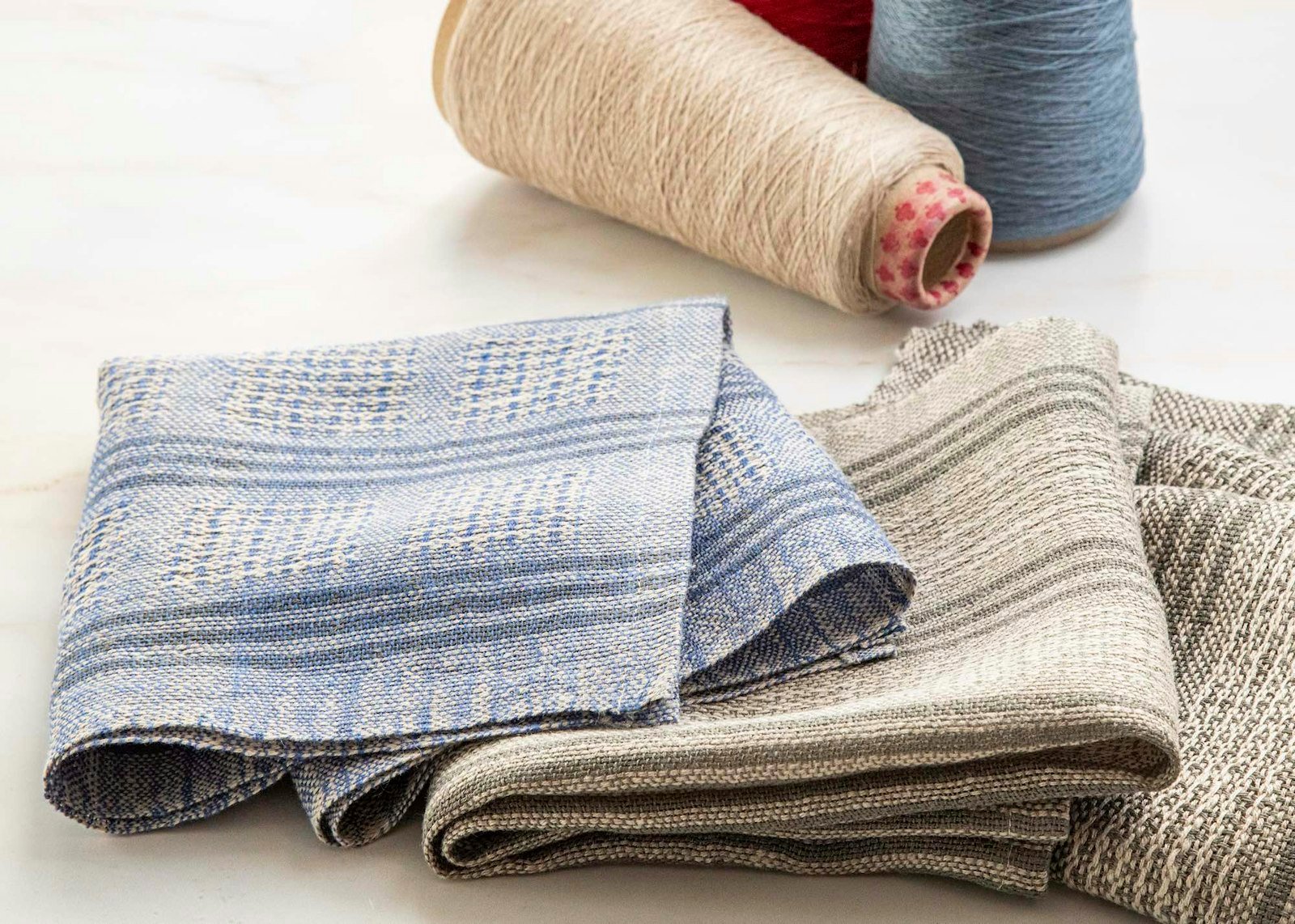
Let’s talk about warping and weaving with linen on the rigid-heddle loom.
Linen yarn has a bit of a bad reputation, and many rigid-heddle weavers avoid using 100% linen yarns—especially in the warp. However, what if I told you that there are ways to tame linen yarn so it is about as easy to warp and weave as cotton?
Almost all the problems that linen poses to rigid-heddle weavers can be traced to two key attributes of linen yarns.
First, linen yarns are notoriously inelastic.
Second, when linen yarns dry out, they become stiff and more prone to breakage.
The key to weaving with linen is to find ways to manage the yarn to prevent problems—in other words, you need to go on the offense. Don’t worry—you don’t have to come up with these methods yourself. Malynda Allen has already done the work for you!
 Malynda’s Camelot Towels from Summer 2024 were her first project to use linen in both the warp and weft. Photo by Matt Graves
After seeing that Malynda wove her incredible Country Linen Towels using 40/2 linen on the rigid-heddle loom, I asked her to write an article about her tips and tricks for handling this finicky fiber. Fortunately for all of us, she said yes, and you can find her full article, “Afraid of Weaving with Linen? Don’t Be!” in the Summer 2026 issue, along with her towels.
Her article is chock full of tips and tricks—ones I’d never heard before. Even more impressive, Malynda lives in a dry climate, so she can’t rely on natural humidity; if anything, the air in her home is actively working against her.
I highly suggest reading Malynda’s article because it is just so good, but if you’re still not convinced, here are three of my favorite tips and tricks.
3 Top Tips for Weaving with Linen
Mist Your Warp
Malynda keeps a spray bottle of water by her loom so she can mist her linen warp ends before and during weaving. This small amount of moisture both strengthens and softens the stiff linen yarns, making for a smoother weaving experience.
 Keep a small spray bottle nearby so you can mist your linen warp ends before and during weaving. Photo by Malynda Allen
Relax Your Warp
Any time you stop weaving, slightly release the tension on your warp. When you’re at the loom, you can spray the warp with water to keep it moist and strong, but when you leave—and stop misting—the yarn will dry out and become more brittle. If your warp is at high tension, this can lead to broken warp ends; if it’s relaxed, your warp will stay safe and sound until you’re ready to weave again.
Tension with a Pick-Up Stick
Any time you weave with an inelastic yarn—not just linen—the slot ends will lose their tension faster than the hole ends. Malynda’s solution is to use a pick-up stick. Before weaving, she puts her heddle in the down position, inserts a pick-up stick into the shed behind the heddle, and then slides the pick-up stick to the back of the loom. When she’s weaving with the heddle in the down position, she wiggles or tilts the pick-up stick to tension just the slot ends.
 After placing your pick-up stick, wiggle or tilt it to tension just the slot ends. Photo by Malynda Allen
While I’ve yet to put linen on my rigid-heddle loom (it’s on my list for later this year), I have tried Malynda’s pick-up-stick tip to get better tension on my 8/2 cotton warps, and it immediately made a huge difference in my weaving experience. After a few picks, using the pick-up stick in every down shed became part of the process, and I ended up weaving faster and more efficiently because I wasn’t dealing with a droopy warp. Even better? I also had fewer unwanted floats to fix!
These are just three of the amazing tips and tricks you’ll find in Malynda’s full article in our Summer 2026 issue. I hope after learning Malynda’s approach, you’ll feel inspired to put a linen warp on your rigid-heddle loom and give some linen towels a try.
If you’re looking for a good first project—but aren’t quite ready to use 40/2 linen, Malynda’s Camelot Towels from Summer 2024 use a combination of beginner-friendly 10/2 and 18/3 linens in the warp.
Happy Weaving!
Christina