

Contents
Learning how to read charts is an essential part of weaving on the rigid-heddle loom. Once you can interpret the color and sleying orders, a whole new world of weaving will open up for you. In this exclusive guide, you'll get all the information you need to read these handy charts. Happy Weaving!—Christina
Weaving patterns include a variety of charts and graphs to convey detailed information in a concise manner.
Weaving graphs are generally called drafts, and for rigid-heddle weaving, there are three main types you’ll see Easy Weaving with Little Looms: warp color order (sometimes called the threading), weft order, and sley charts.
Reading the Warp Color Order
The threading or warp color order portion of a draft provides the sequence for warping your yarns and is read right to left. Each row in the warp color order represents a different color. To save space, wherever a section of the draft is repeated, a bracket is placed above it with the number of times to do that section.
For example, for the warp color order for the Butterfly Wings Scarf by Sara Goldenberg White (shown below), you start to thread with:
- 11 ends of Radiant Orchid
- 1 end Black Cotone
- 11 ends Celosia Orange
- 1 end Black Cotone
- 11 ends Scuba Blue
- 1 end Black Cotone
- And then 11 ends Green Glow
Next, we move on to the section under a bracket labeled 2x, which means that the ends under the bracket are threaded twice before moving on. Start by threading 11 ends Radiant Orchid, 1 end Black Cotone, etc., until you reach the 11 ends of Green Glow. Repeat the color order and then continue along the rest of the warp color order, starting with 11 ends of Scuba Blue.
 Warp Color Order for Sara Goldenberg White's Butterfly Wings Scarf.
Using a Warping Board
If you prefer to use a warping board to wind your warp, you can follow the chart in the same way, winding each color as you make your way across the chart. The numbers at the far left let you know how many ends of each color you need to thread or wind in total. Note that in some drafts, 1 end equals 2 or more strands or threads because the yarn is used double or even triple. If that is the case, it should be clearly noted in the project instructions.
Using a Sley Chart
Alongside the warp color order, you might see a sley chart. This chart accompanies projects with complicated threadings that might include multiple ends threaded through one slot or hole or areas where they are skipped.
In the Sea Slug Silken Splendor Scarf by Peg MacMorris, shown below, there are two rows: the top row for warp ends threaded through holes and the bottom row for ends threaded through slots. Colored circles indicate individual warp ends. Similar to the brackets used to indicate repeats in the warp color order, bottom brackets and dashed lines are used to show when multiple ends need to be threaded as one. Asterisks, placed at the bottom of the chart, show where dents should be skipped.
 Sleying chart for Peg MacMorris's Sea Slug Silken Splendor Scarf.
Weft Color Order Charts
Some projects might also have a weft color order, which is read from top to bottom (opposite the direction of weaving).
In the weft color order for napkin #4 in the Mud Cloth Napkins by Elisabeth Hill, shown below, you'd begin by weaving 6 picks of 10/2 cotton for hems. Then you'd weave 234 picks of K-6 Taisha, and finally 6 picks of 10/2 cotton.
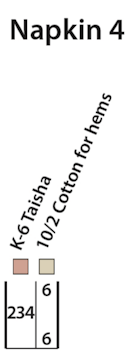
Weft Color order for napkin #4.
Let's look at a more complicated pattern. In napkin #3 below, we see the addition of brackets in the weft color order, which directs you to repeat for a specific length or a certain number of repeats. In the weft color order for napkin #3:
- Begin by weaving 6 picks of 10/2 cotton.
- Then weave 12 picks of the K-3 Fukagawa before starting the 4x bracket.
- For the bracket section weave:
- 12 picks of K-3 Fukagawa
- 2 picks of K1-Kosyoku
- 12 picks of K-10 Tencha
- 2 picks of K1-Kosyoku
- 12 picks of K-12 Ajisai
- and finally 2 picks of K1-Kosyoku
- This section is woven a total of 4 times, and then you move on to the final weft picks.
Sometimes in a weft color order, you’ll see a bracketed section with a certain length indicated rather than a specific number of repeats. In that case, repeat the bracketed section for the indicated length, even if it means not finishing with a full repeat of the bracketed section.
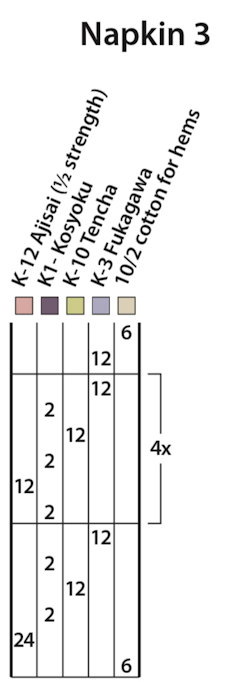
Weft Color order for napkin #3.
When weaving projects with a complicated weft order, keep a copy of it near your loom and use a sticky note to cover the portions you’ve already woven so you always know where you are in your weaving. While they might seem confusing if you don’t know what these figures are or how to read them, once you understand warp color orders, sley charts, and weft color orders, you can read a lot of information about a project in a short time.
Originally published in Easy Weaving with Little Looms Spring 2020 issue